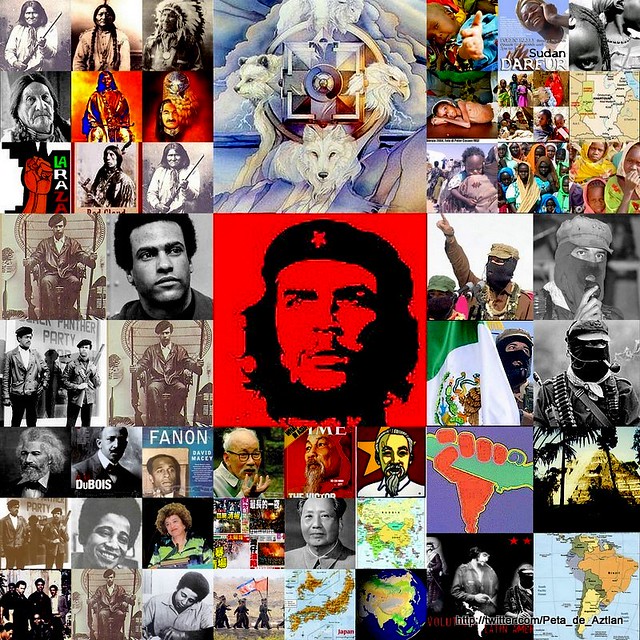
Sent with a healthy veteran's day wish for all vets! My war rages on!
IF we must fight with arms we must FIGHT only just wars, not fascist-imperialist wars! Be a merciful warrior, not a mercenary killer!
Bring the war home! Our real battles are here in the continental U.S.A.
++++++++++++++++++++++++++++
US: Rocket, mortar fire in Iraq
Monday, November 12, 2007
BAGHDAD - Rocket and mortar attacks in Iraq have decreased to their lowest levels in more than 21 months, the U.S.
Last month saw 369 "indirect fire" attacks — the lowest number since February 2006. October's total was half of what it was in the same month a year ago. And it marked the third month in a row of sharply reduced insurgent activity, the military said.
The U.S. command issued the tallies a day after Iraqi Prime Minister Nouri al-Maliki said suicide attacks and other bombings in Baghdad
A top U.S.
Total rocket and mortar attacks rose steadily from 808 in January 2007 to a peak of 1,032 in June, before falling over the next four months, a U.S.
That decline also was seen in Baghdad
On Sunday, al-Maliki said "terrorist acts" including car bombings and other spectacular, al-Qaida-style attacks dropped by 77 percent in the capital. He called it a sign that Sunni-Shiite violence was nearly gone.
"We are all realizing now that what Baghdad was seeing every day — dead bodies in the streets and morgues — is ebbing remarkably," al-Maliki told reporters at his office in the U.S.-guarded Green Zone.
"This is an indication that sectarianism intended as a gate of evil and fire in Iraq
Associated Press figures show a sharp drop in the number of U.S.
The number of American military deaths fell from 65 to at least 39 over the same period.
Before the arrival of nearly 30,000 U.S. reinforcements this past spring, explosions shook Baghdad Tigris River
Now the sounds of warfare are rare. American troops have set up small outposts in some of the capital's most dangerous enclaves. Locals previously lukewarm to the presence of U.S. Tigris is set to reopen later this year, lined with seafood restaurants and an art gallery.
Maj. Gen. Rick Lynch, commander of U.S. forces south of the capital, said Sunday he believed the decrease would hold, because of what he called a "groundswell" of support from regular Iraqis.
"If we didn't have so many people coming forward to help, I'd think this is a flash in the pan. But that's just not the case," Lynch told a small group of reporters over lunch in the Green Zone.
He attributed the sharp drop in attacks to the American troop buildup, the setup of small outposts at the heart of Iraqi communities, and help from locals fed up with al-Qaida and other extremists.
"These people — Sunni and Shiite — are saying, `I've had enough,'" Lynch said.
The U.S. Baghdad and all of Karbala , Najaf and Wassit province along the Iranian border, is about the size of the U.S. state of West Virginia
Some 17,000 of those people, whom the U.S.
"They live there, and they know who's the good guy and who's the bad guy," he said.
Such local expertise has paid off for American troops and their Iraqi counterparts, who have killed or captured about 3,000 insurgents in the area in the past year, Lynch said.
Since November 2006, tips from local citizens have helped U.S. troops confiscate 2,470 rocket and mortar caches across Iraq , the U.S.
Also Monday, the mayor of a northern Iraqi city told the AP that Iraqi soldiers killed four men in clashes that lasted throughout the night.
Hours after a tribal chieftain was killed in front of his village's mosque, Iraqi soldiers stormed the area and engaged armed men in an hours-long battle, killing four of them and wounding two, said Tal Afar Mayor Gen. Najim Abdullah. Troops also seized a machine gun and some rifles, he said.
Abdullah said several other men were arrested, and later confessed to the sheik's killing as well as other murders in the area. He did not give a number of those arrested.
Tal Afar is an ethnically mixed city about 90 miles east of the Syrian border, and 260 miles northwest of Baghdad
++++++++++++++++++++++++++++
Half a Million U.S.
BY Aaron Glantz, OneWorld US
Fri Nov 9, 2007 @12:52 PM ET
LOS ANGELES, Nov 9 (OneWorld) - As Americans prepare to honor their military veterans with parades and patriotism this weekend, a new study shows that 494,500 U.S.
Close to 200,000 veterans are homeless on any given night. The study, by the National Alliance to End Homelessness, found that about half of homeless vets are Vietnam veterans and at least 1,500 are newly returned from Iraq or Afghanistan
Among them is 23-year-old Jason Kelley. Kelley grew up in Tomahawk, Wisconsin, a small town of just 3,700 in the state's great Northwoods near the Canadian border. A strong man with a sharp face, he spent a year in the army guarding convoys on their 14-hour drive between Kuwait and Camp Anaconda in Balad, north of Baghdad Iraq
Medically evacuated back to the United States because of severe post traumatic stress disorder, Kelley returned to Tomahawk but didn't fit in. "I was bored," he deadpanned, in a recent conversation with OneWorld. "There's not much to do there."
Three months later, Kelley moved to Los Angeles
"I got stuck in a little predicament where I couldn't get a job because I didn't have an apartment and I couldn't get an apartment because I didn't have a job," he said. "The money I saved up in Iraq
After just a few weeks on the street, Kelley brought himself into a residence hall run by U.S.
Such services are not readily accessible to most veterans, however. According to the Department of Veterans Affairs (VA), the U.S.
An even bigger problem, said John Driscoll of the National Coalition for Homeless Veterans, is that after finding space in a shelter and stabilizing themselves, many vets still can't afford permanent housing.
"The VA programs go a long way in developing transitional assistance programs," he said. "The problem is that most of these programs only help the veteran for up to two years. Most veterans who successfully complete that program are not able to afford fair market rents in virtually any community in the country. Unless there are rental supports, that veteran is still at risk of being homeless after he gets out of that program."
Pentagon statistics show American soldiers are disproportionately recruited from poor, inner city, and rural areas. Many join the military primarily to get out of that environment.
"What typically happens to young adults who go into the military at 17 or 18 [is that] when they return home, the same kind of economic conditions that forced them towards the military still exist or have gotten worse," said Ricky Singh of Black Veterans for Social Justice.
Singh appears in the documentary film, "When I Came Home," which tells the story of Iraq war veteran Herold Noel, who had to live out of his jeep when he returned to New York with post traumatic stress disorder. Singh believed veterans should be given special housing dispensation to assist in their transition to civilian life.
"Every person in this country who is incarcerated is given a discharge plan, and part of that discharge plan is a housing plan," Singh said in the film. "It should happen for soldiers too. If a soldier is returning to an unacceptable housing situation, that soldier should have in his hand as part of his discharge a Section 8 (federal housing voucher)."
VA representatives did not return repeated calls for comment on this story.
In September, former VA Secretary Jim Nicholson wrote to prominent senators warning that President Bush would veto key spending bills if Congress increased funding for veterans beyond the relatively modest budget Bush has suggested. The Senate ignored the warning, passing a larger VA budget by a vote of 92-1.
Vets looking for a place to turn can call the National Veterans Foundation's crisis hotline at 888-777-4443.
+++++++++++++++++
Paying for the Wars' Wounded
Col. Daniel Smith, U.S.
The Bureau of the Census has issued a lengthy summary of "facts" about the nation's 23.7 million veterans in time for Veteran's Day. Considering that there are two significant ongoing armed conflicts involving U.S. forces, I expected that there would be some "facts" dealing with Iraq and Afghanistan
Nothing was disaggregated. Well, nearly nothing. Where detail was provided, it rarely was framed by war as opposed to education, age or ethnicity.
One statistic I did expect was the number of troops "wounded in hostile engagements" who had been discharged from service and transferred to veterans' medical care. (According to the Pentagon, total U.S. wounded from enemy action in Iraq is 28,327 and in Afghanistan
Medical Care
Thinking these two items might be linked, I re-read the notice looking for spending just on veterans' medical care. Dead last was total spending by the VA in 2006 and a breakout between medical and non-medical spending for that year.
As a veteran who uses the military medical system, I could not help but wonder if the placement of this information was nothing more than happenstance, a fading echo of the recently revealed mishandling of war wounded and not a harbinger of the how the wounded from Iraq and Afghanistan will be regarded in the priorities of future administrations.
Actually, the census report raised more questions than it answered. Looking through the Bush administration's proposed Fiscal Year 2008 Budget submission turned up the following:
In 2006, the Bush administration's budget request for the Veterans Health Administration (VHA) was still less than half ($31.3 billion) the total request ($75.7 billion) for the Department of Veterans Affairs.
In 2007, the VHA's budget request actually dropped from about 43% of the total Veterans Administration proposed budget to 40%. Congress added $1.8 billion in the 2007 supplemental.
The White House however, does not seem able to fathom the long-term medical costs of the Iraq War and its Afghanistan
Supporting the Troops
The public comprehends the principle that if the nation sends its youth to war, it owes those young men and women the best medical care regardless of cost should they be wounded. This distinction is a variation of the classic "support the troops – support the war" dichotomy that scares and scars politicians. In an age of 15-second sound bites, all that need be said is "Senator (or Representative) X voted against funding our troops in the field," letting the silence of the syllogistic "therefore" be completed by the voter: that in refusing to vote for the military's budget request the congressional incumbent doesn't care about either the dead or the living.
Regardless of the precipitating event, once the armed forces are "on the ground," the president of the United States
Ironically, even when the wars they wage are as widely unpopular as today's operations in Iraq and Afghanistan, presidents can blackmail the American people the same way – and they get away with it for the same reason: no one wants to be accused of not standing up for the troops or appear to be unwilling to give them the best of everything. This stems from the belief that the United States
The Warriors
In accepting the demise of the conscript army and the emergence of the modern military professional, the American public assigned the responsibility for military defense to a class of people – the Warriors – and in typical fashion, turned their attention elsewhere. This left as the main advocates for post-military service benefits (other than the formal institutions of government) the traditional veterans' advocacy organizations such as the Veterans of Foreign Wars (VFW), AMVETS, and the American Legion.
In peacetime, this façade of a "caring" nation could be maintained with little more than the ritual appearance by the "commander-in-chief" (and in election years by candidates for president) at veterans' conventions and the odd extra half-billion or billion dollars in additional spending that was never enough to catch up with needed improvements in the military and veterans health systems.
Under pressure from two wars, the "center" could not sustain itself or conceal the dichotomy between excellent medicine and paralyzing administrative requirements.
Walter Reed Effect
Then came what could be termed the "Walter Reed effect": the "fall-out" from investigative reporting by The Washington U.S.
Initially, this renewed concern for the warriors and the question of why their care was so remiss did not cross into questioning the war itself, perhaps because one could, in the early days, talk war without having to talk veterans. And when veterans were mentioned, the traditional veterans groups stepped forward, as they had in the past, and generally supported the president's policy.
It would not be too long, however, before voices of returned soldiers, wounded or not, and of the survivors of those killed in Iraq and Afghanistan were raised in protest – first singly and then collectively in new groups such as Iraq Veterans Against the War, Veterans Against the Iraq War, and even among the veterans of the Vietnam War.
As the extent of the deficiencies became clearer, as more and more members of Congress visited hospitals and saw first-hand the extensive physical and mental injuries, as they learned of the extensive treatments that would have to last a lifetime, they at last began to fathom the woeful under funding of veteran's health and rehabilitation costs.
The apparent callousness of top Army officials to the status quo did not sit well with the public. This perception of official indifference acted as a catalyst to re-engage the American public on the issue of why these wars with their ever-increasing casualties hadn't ended.
Vets Find Their Voices
Veterans of the fighting in Iraq and Afghanistan
Indeed, today's wounded (and today's 3,858 dead in Iraq and 459 in Afghanistan) present the public with an opportunity to start to end the fighting, the dying, and the maiming that seem to be endemic in the "social contract" of modern nation states. How? By bringing face-to-face those who serve with those who first asked them to serve, sent them to "care" for (that is, to fight for) the nation, and in so doing created a moral and even a legal reciprocal obligations to care for the wounded who "cared" for the nation when asked.
While this approach might seem to leave a huge gap through which to drive a tank army, it would strip away the sterile masks that protect those who make war from those who "do" war – at the maker's behest and in the name of the "people" who often have absolutely no say in the decision for war.
It's different today than during the Vietnam War, when even wounded veterans were sometimes reviled and taunted as "baby-killers." Vietnam may have been the tipping point, for that was the first U.S. Iraq and Afghanistan
The challenge is how to keep together the need for adequate appropriations to care for the wounded for as long as necessary with the realization that those who need long-term care once were able-bodied men and women. Still to be traversed is the gap between the recognition of the cost of caring for the wounded and caring about – that is, rejecting – the reasons why politicians opt for war in the first instance.
Meanwhile, the number of mercenaries (politely termed "security contractors" in the mainstream media and political debate) just in Iraq
So now there is another consideration: will the public, and the Congress, in rebelling against the cost of paying for war and the war-wounded, opt for a fully mercenary force to wage our wars?
That was what Rome
- - - - - - - - - - - - - - - - - -
Dan Smith is a military affairs analyst for Foreign Policy In Focus (www.fpif.org), a retired U.S.
++++++++
as "Armistice Day" on Nov. 11, 1919, the first anniversary of the end of
and Nov. 11 became a national holiday beginning in 1938. President Dwight
D. Eisenhower signed legislation in 1954 to change the name to Veterans Day
as a way to honor those who served in all American wars. The day has
evolved into also honoring living military veterans with parades and
speeches across the nation. A national ceremony takes place at the Tomb of
the Unknowns at Arlington National Cemetery in Virginia
23.7 million
The number of military veterans in the United States
(Source: Table 505 of the upcoming Statistical Abstract of the United
States: 2008.)
Female Veterans
1.7 million
The number of female veterans in 2006.
(Source: Table 505 of the upcoming Statistical Abstract of the United
States: 2008.)
16%
Percentage of Gulf War veterans in 2006 who were women.
(Source: Table 506 of the upcoming Statistical Abstract of the United
States: 2008.)
Race and Hispanic Origin
2.4 million
The number of black veterans in 2006. Additionally, 1.1 million
veterans are Hispanic; 292,000 are Asian; 169,000 are American Indian or
(The numbers for blacks, Asians, American Indians and Alaska
Native Hawaiians and Other Pacific Islanders cover only those reporting a
single race.) (Source: 2006 American Community Survey.)
When They Served
9.2 million
The number of veterans 65 and older in 2006. At the other end of the
age spectrum, 1.9 million were younger than 35.
(Source: Table 506 of the upcoming Statistical Abstract of the United
States: 2008.)
8 million
Number of Vietnam-era veterans in 2006. Thirty-three percent of all
living veterans served during this time (1964-1975). In addition, 4.6
million served during the Gulf War (representing service from Aug. 2, 1990,
to present); 3.2 million in World War II (1941-1945); 3.1 million in the
Korean War (1950-1953); and 6.1 million in peacetime. (Source: Table 506 of
the upcoming Statistical Abstract of the United States
430,000
In 2006, number of living veterans who served during both the Vietnam
era and the Gulf War.
Other living veterans in 2006 who served in two or more wars:
-- 350,000 served during both the Korean and Vietnam
-- 78,000 served during three periods: World War II, the
Korean War and the Vietnam War.
-- 294,000 served in World War II and the Korean War.
(Source: 2006 American Community Survey.)
3The documented number of living World War I veterans who served with
U.S. forces as of Oct. 2, 2007. (Source: Department of Veterans
Affairs)Where They Live
6
Number of states with 1 million or more veterans in 2006. These states
are California (2.2 million), Florida (1.7 million), Texas
(Source: Table 505 of the upcoming Statistical Abstract of the United
States: 2008.)
Education25%
Percent of veterans 25 and older with at least a bachelor's degree in
2006. (Source: 2006 American Community Survey.)
90%Percent of veterans 25 and older with a high school diploma or
higher in 2006. (Source: 2006 American Community Survey.) Income and
Poverty$34,437Annual median income of veterans, in 2006 inflation-adjusted
dollars. (Source: 2006 American Community Survey.) 5.9%Percentage of
veterans living in poverty, as of 2006. The corresponding rate for
nonveterans was 12.3 percent. (Source: 2006 American Community Survey.) On
the Job11.1 millionNumber of veterans 18 to 64 in the labor force in 2006.
(Source: 2005 American Community Survey.) Disabilities6.1 million
Number of veterans with a disability. More than half this number (3.5
million) were 65 and older. (Source: 2006 American Community Survey.)
Voting17.4 millionNumber of veterans who voted in the 2004 presidential
election. Seventy-four percent of veterans cast a ballot, compared with 63
percent of nonveterans. (Source: Voting and Registration in the Election of
November 2004, at
http://www.census.gov/Press-Release/www/releases/archives/voting/006562.htm
l )Business Owners14.5% Percentage of owners of firms that responded to the
2002 Survey of Business Owners who were veterans. Respondent veteran
business owners totaled 3 million. (Source: Characteristics of
Veteran-Owned Businesses: 2002 at
http://www.census.gov/Press-Release/www/releases/archives/business_ownershi
p/010337.html)68%Percentage of veteran owners of respondent firms who were
55 and older. This compares with 31 percent of all owners of respondent
firms. Similarly, in 2002, 55 percent of veteran-owned respondent firms
with employees reported that their businesses were established, purchased,
or acquired before 1990, compared with 36 percent of all employer
respondent firms. (Source: Characteristics of Veteran-Owned Businesses:
2002 and Characteristics of Veteran Business Owners: 2002, at
http://www.census.gov/Press-Release/www/releases/archives/business_ownershi
p/010337.html)7%Percentage of all respondent veteran owners who were
disabled as the result of injury incurred or aggravated during active
military service. (Source: Characteristics of Veteran-Owned Businesses:
2002 and Characteristics of Veteran Business Owners: 2002, at
Benefits2.7 millionNumber of veterans who received
compensation for service-connected disabilities as of 2006. Their
compensation totaled $26.6 billion.
(Source: Tables 508 and 509 of the upcoming Statistical Abstract of the
Jan. 21, 2007
The date of death of the last World War I veteran receiving
compensation or pension from the Department of Veterans Affairs. (Source:
Department of Veterans Affairs)
$72.4 billion Total amount of federal government spending for veterans
benefits programs in fiscal year 2006. Of this total, $34.5 billion went to
compensation and pensions and $31.3 billion for medical programs. (Source:
Table 508 of the upcoming Statistical Abstract of the United States
Following is a list of observances covered by the Census Bureau's Facts
for Features series in 2007:African-American History Month (February) Super
Bowl XLI (Feb. 4) Valentine's Day (Feb. 14) Women's History Month (March)
Irish-American Heritage Month (March)/ St. Patrick's Day (March 17)
Asian/Pacific American Heritage Month (May) Older Americans Month (May)
Cinco de Mayo (May 5) Mother's Day (May 13) Hurricane Season Begins (June
1) Father's Day (June 17) The Fourth of July (July 4) Anniversary of
Americans with Disabilities Act (July 26)Back to School (August)Labor Day
(Sept. 3)Grandparents Day (Sept. 9)Hispanic Heritage Month (Sept. 15-Oct.
15)Halloween (Oct. 31) Unmarried and Single Americans Week (Sept. 16-22)
Sputnik Launch 50th Anniversary (Oct. 4) American Indian/Alaska Native
Heritage Month (November) Veterans Day (Nov. 11) Thanksgiving Day (Nov. 22)
The Holiday Season (December)
Editor's note: The preceding data were collected from a variety of
sources and may be subject to sampling variability and other sources of
error. Facts for Features are customarily released about two months before
an observance in order to accommodate magazine production timelines.
Questions or comments should be directed to the Census Bureau's Public
Information Office: telephone: 301-763-3030; fax: 301-763-3762; or e-mail:
SOURCE U.S.
--------------------------------------------------------------------------------
Related links:
+++++++++++++++++
Posted on: November 3, 2007 - 10:35am by Aaron Glantz
Email This
Soldiers returning from Iraq
And so, across the country, we see stories of what on the surface seem like extremely bizarre crimes:
From the October 28th edition of North Carolina
Three people, including a 5-year-old, are dead from gunshots in an apparently random murder-suicide committed Friday in a normally placid, rural neighborhood in the Holden Beach
All three people were shot with the same gun, Hewett said at a Saturday afternoon news conference announcing the deaths and the belief that [Joshua] Outlaw shot the woman and her child, for reasons unknown.
Outlaw was honorably discharged from the Marines about six weeks ago after serving three tours of duty in Iraq Europe and had only been in the country for about two weeks. Outlaw was staying nearby with his family, who are related to Williams' branch of the family and from whom she leased the trailer home.
From the November 2nd of Champaign , IL
21-year veteran of the Army National Guard told authorities he stole tens of thousands of dollars worth of military equipment because "it was easy and he thought the Army was not treating him fairly."
Asked if the representations spelled out in his written plea agreement were accurate, Christopher Henkel told a federal court judge in Urbana
The 1993 architecture graduate of the University of Illinois
In laying out the facts for the Judge, US Attorney Bruce said investigators from the Department of Defense and the FBI learned that Henkel was not only selling military items from his Decatur home to people working undercover with the government but also on eBay, an online marketplace.
You can also check out the story of Staff Sgt. Michael Hall from this website. He came home and started dealing meth "to dull the pain."
It's not easy to come home from a war. Unfortunately, these stories will continue to multiply until veterans of the Iraq
Aaron Glantz's blog
++++++++++++++
At Least 430 Iraq , Afghanistan
Posted on: October 31, 2007 - 1:14pm
By Aaron Glantz
It's time to change of count of American war dead upward.
The Associated Press has got hold of a preliminary government study on suicides by Iraq and Afghanistan Afghanistan Iraq and Afghanistan
The VA's count is not a complete one, however. It does not include members of the military who returned from Iraq
It also doesn't include the deaths of people like Sgt. James Dean who was shot by Maryland
And it doesn't include the deaths of people like Sgt. Gerald Cassidy, a 32 year old Indiana National Guardsman, who died at Fort Knox five months after returning from Iraq
How many more American deaths continue to go uncounted?
Regardless, it's clear is that we need to change our count of casualties upward from 4,229 US military deaths (3,842 in Iraq and 387 in Afghanistan) to closer to 5,000 – possibly more when you consider those deaths that still haven't been counted.
++++++++
Veterans and Military Families Barred From Marching in Veterans Day Parade
The L.A. chapter of Iraq Veterans Against the War was recently denied permission to march in the Long Beach
IVAW-LA and their MFSO and VFP counterparts are conducting a phone campaign to convince the Parade Commissioners and the Long Beach
Martha Thuente, Parade Committee Chairperson: 562-422-6669
Debbie Harn of Pageantry Productions, the company producing the parade: 310-537-4240
Mayor Bob Foster: (562) 570-6801
Val Lurch: 562-570-6137 (The parade is in his district.)
Tonia Reyes Uranga: 562-570-6596
Bonnie Lowenthal: (562) 570-6919
Suja Lowenthal: (562) 570-6684
Patrick O'Donnell: 562.570.6918
Gerrie Schipske: (562) 570-6932
Dee Andrews: (562) 570-6816
Rae Gabelich: (562) 570-6685
Related YouTube Video Clip:
Jason Lemieux Testifies at the Long Beach
Read the story in the Long Beach
+++++++++++++++++++++
Come Together and Create!
Peter S. Lopez ~aka:Peta
Sacramento, California, Aztlan
Email: sacranative@yahoo.com
http://groups.yahoo.com/group/Humane-Rights-Agenda/
http://groups.yahoo.com/group/NetworkAztlan_News/
http://www.networkaztlan.com/
C/S


No comments:
Post a Comment