http://humane-rights-agenda.blogspot.com/2006/05/immigrant-rights-report-monday-may-day.html
zzzzzzzzzzzzzzzzzzzzzzzzzzzzzzzzzzzzzapata
http://www.nytimes.com/2006/05/02/us/02immig.html?hp&ex=1146628800&en=7e11df6de8b4ca07&ei=5094&partner=homepage
Immigrants Take to U.S. Streets in Show of Strength: Posted 10:00 PM / PDT=PSL
May 2, 2006
By RANDAL C. ARCHIBOLD
LOS ANGELES, May 1 — Hundreds of thousands of immigrants and their supporters skipped work, school and shopping on Monday and marched in dozens of cities from coast to coast.
The demonstrations did not bring the nation to a halt as planned by some organizers, though they did cause some disruptions and conveyed in peaceful but sometimes boisterous ways the resolve of those who favor loosening the country's laws on immigration.
Originally billed as a nationwide economic boycott under the banner "Day Without an Immigrant," the day evolved into a sweeping round of protests intended to influence the debate in Congress over granting legal status to all or most of the estimated 11 million illegal immigrants in the country.
The protesters, a mix of illegal immigrants and legal residents and citizens, were mostly Latino, but in contrast to similar demonstrations in the past two months, large numbers of people of other ethnicities joined or endorsed many of the events. In some cases, the rallies took on a broader tone of social action, as gay rights advocates, opponents of the war in Iraq and others without a direct stake in the immigration debate took to the streets.
"I think it's only fair that I speak up for those who can't speak for themselves," said Aimee Hernandez, 28, one of an estimated 400,000 people who turned out in Chicago, the site of one of the largest demonstrations. "I think we're just too many that you can't just send them back. How are you going to ignore these people?"
But among those who favor stricter controls on illegal immigration, the protests hardly impressed.
"When the rule of law is dictated by a mob of illegal aliens taking to the streets, especially under a foreign flag, then that means the nation is not governed by a rule of law — it is a mobocracy," Jim Gilchrist, a founder of the Minutemen Project, a volunteer group that patrols the United States-Mexico border, said in an interview.
While the boycott, an idea born several months ago among a small group of grass-roots immigration advocates here, may not have shut down the country, it was strongly felt in a variety of places, particularly those with large Latino populations.
Stores and restaurants in Los Angeles, Chicago and New York closed because workers did not show up or as a display of solidarity with demonstrators. In Los Angeles, the police estimated that more than half a million people attended two demonstrations in and near downtown. School districts in several cities reported a decline in attendance; at Benito Juarez High School in Pilsen, a predominantly Latino neighborhood in Chicago, only 17 percent of the students showed up, even though administrators and some protest organizers had urged students to stay in school.
Lettuce, tomatoes and grapes went unpicked in fields in California and Arizona, which contribute more than half the nation's produce, as scores of growers let workers take the day off. Truckers who move 70 percent of the goods in ports in Los Angeles and Long Beach, Calif., did not work.
Meatpacking companies, including Tyson Foods and Cargill, closed plants in the Midwest and the West employing more than 20,000 people, while the flower and produce markets in downtown Los Angeles stood largely and eerily empty.
Israel Banuelos, 23, and more than 50 of his colleagues skipped work, with the grudging acceptance of his employer, an industrial paint plant in Hollister, Calif.
"We were supposed to work," Mr. Banuelos said, "but we wanted to close down the company. Our boss didn't like it money-wise."
The economic impact of the day's events was hard to gauge, though economists expected a one-day stoppage to have little long-term effect. In large swaths of the country, life went on with no noticeable difference. But protesters in numerous cities, many clad in white and waving mostly American flags in response to complaints that earlier rallies featured too many Latin American ones, declared victory as chanting throngs shut down streets.
Most of the demonstrators' ire was directed at a bill passed by the House that would increase security at the border while making it a felony for an illegal immigrant to be in the country or to aid one. The marchers generally favored a plan in the Senate, for which President Bush has shown signs of support, that would include more protection at the border but offer many illegal workers a path to citizenship.
Still, the divide among advocates over the value and effectiveness of a boycott resulted in some cities, including Los Angeles and San Diego, playing host to two sizable demonstrations, one organized by boycotters and the other by people neutral or opposed to it.
That split played out across the country. While many business owners warned employees about taking the day off, many others also sought to negotiate time off or other ways to register workers' sentiments.
Las Vegas casinos reported few disruptions, partly because many of their owners announced their support for workers at a news conference last week. On Monday, more than 40 casinos set up tables in employee lunchrooms for workers to sign pro-immigration petitions. Leaders of Local 226 of the Culinary Workers Union also urged members to go to work. The union is Las Vegas's largest hospitality union, representing 50,000 workers, of which 40 percent are Hispanic. Smaller businesses in Las Vegas, where tens of thousands of demonstrators gathered on the Strip, also took a hit. Javier Barajas said he closed his family's four Mexican restaurants in Las Vegas because members of his staff warned him they would not show up, costing him more than $60,000 in revenue.
"I cannot fire anybody over this, but I would have liked to see some other way to express themselves," said Mr. Barajas, who was once an illegal immigrant from central Mexico but became a United States citizen. "It's the small businesses that are hurt by this."
For many immigrants, however, it was just another workday.
At a Home Depot in Hollywood, day laborers as always crowded parking lot entrances, hoping for work. At a car wash in the Echo Park neighborhood of Los Angeles, employees buzzed, with workers vacuuming, buffing and drying cars. People lined up at markets, though some reported slower business.
"I was thinking about not buying things, but then I needed to buy stuff," said Alex Sanchez, 28, a construction worker buying an avocado, chilies and beer.
The boycott grew from an idea hatched by a small band of grass-roots advocates in Los Angeles, inspired by the farmworker movement of the 1960's led by Cesar Chavez and Bert Corona. Through the Internet and mass media catering to immigrants, they developed and tapped a network of union organizers, immigrant rights groups and others to spread the word and plan events tied to the boycott, timed to coincide with International Workers' Day.
The Los Angeles organizers said some 70 cities held boycott activities.
The day spawned all manner of supportive actions here. A department store chain offered space for lawyers to give legal advice to immigrants; in Hollywood, the comedian Paul Rodriguez appeared at the comedy club the Laugh Factory to promote a daylong health care fair for immigrant workers.
In Chicago, there was solidarity in diversity, as Latinos were joined by immigrants of Polish, Irish, Asian and African descent. Jerry Jablonski, 30, said he had moved to Chicago from Poland six years ago, flying to Mexico and then crossing the border. He now works a construction job. "Poland is my old country," Mr. Jablonski said. "This is my new country. I can make everything happen here."
Reporting for this article was contributed by Cindy Chang from Los Angeles, Steve Friess from Las Vegas, Carolyn Marshall from Watsonville, Calif., and Gretchen Ruethling from Chicago.
zzzzzzzzzzzzzzzzzzzzzzzzzzzzzzzzzzzzzzapata
http://www.latimes.com/news/local/la-050106immig_lat,0,5992605,full.story
Immigration Dissent Sweeps L.A. and the Nation: 8:09 PM PDT, May 1, 2006
By Michael Muskal, Times Staff Writer
Hundreds of thousands of undocumented workers and their supporters demonstrated today in Los Angeles and flexed their political and economic muscles in support of an overhaul of national immigration policy.
About 250,000 people attended the early demonstration in front of City Hall and a crowd estimated at more than 400,000 worked its way from MacArthur Park to La Brea Avenue in the afternoon. Tens of thousands more demonstrated across the region and hundreds of thousands took to the streets from coast to coast.
At 7:40 p.m., with the words "Go in peace, God bless America" echoing from the stage at La Brea and Wilshire, the afternoon march officially ended. A huge crows remained, but many began drifting away, as they had been for a couple hours.
It was hard to get an exact number of those protesting because many who attended the early rally also moved to the later one. But the final number was likely to approach or surpass the record rally on March 25 when half a million people protested federal efforts to make enforcement tougher on undocumented immigrants.
Mayor Antonio Villaraigosa estimated nearly a million people demonstrated throughout the day. "We come to work, we come for a better life, we come to participate for the American dream," he told the marchers on Wilshire at La Brea this evening.
The local protests, part of a national day of demonstration, was in response to efforts by Congress to overhaul immigration policy for the first time in two decades. But it has become something more, a cry from the normally hidden undocumented community for a way to socially and economically come into the sunlight.
"If we didn't come, who will build the houses?" asked Jose Abrego, 40, from Acapulco, one of the thousands in MacArthur Park. "We're not flowers. We're not asking to be treated delicately. We just want respect." Abrego said he came in July to do construction work so he could save money to build his own house back home, where he earned about $100 a week driving trucks. Here he earns about $400 a week. "We are asking the rich of the United States to respect us," he said.
It was a day of jubilation for demonstrators across the city. Those congregating in front of City Hall had marched blocks through downtown, where seldom anyone is seen walking. It was the second major demonstration to rock the city in less than two months as festive protesters paraded to the Latin rhythms. Across the street from their destination, they heard the blaring of Neil Diamond's "America," which has become an immigrant musical cry.
"I am part of this," said Ofelia Luna, 42, now a U.S. citizen after holding a green card for nearly two decades. "I want my voice to be heard."
The biggest cheers seemed to come around 1:40 p.m. when the popular disc jockey, Eddy "El Piolin" Sotelo spoke. "We have the same heart, we believe in the same God," he told the crowd.
Rev. Lewis Logan II, pastor at Bethel AME Church in South L.A., also praised the crowd: "A power more powerful than Katrina has been unleashed here in Los Angeles." Speaking from a raised platform at the side of City Hall, he got his biggest cheers when he said, "What are we here for?"
The crowd responded: "To triumph, to succeed." Many waved their U.S. flags, bought from vendors for $2 along the route.
In the nearby bastions of municipal power, officials monitored the situation on the streets.
"All is well," Mayor Antonio Villaraigosa, who had urged students to stay in school and away from the earlier demonstration, told reporters at a later briefing. "This march — protest, as it's developed, has been very peaceful as we suspected from the beginning."
The mayor's teenage son had planned to join the protests after school with his father's approval. Villaraigosa did not speak at the downtown rally, but said he might at the later demonstration, depending on his schedule. He was to fly to Dallas at 7 p.m. to lobby NFL owners for a professional football team in Los Angeles.
"I'm mayor for all the people," Villaraigosa said. "But without question, I'm also someone who is a proud American, [and] also proud of where my family came from. I've never been shy about the fact that these people out here want to be a part of the American dream. I support them. I don't necessarily have to make every single demonstration to manifest that support."
The crowd overflowed City Hall Plaza and filled the green areas that serve as a buffer for the official buildings. Dressed in white for peace, people waved American flags as they roared what they hope would be a demand heard across the nation in Washington.
Many then went home, but others headed to MacArthur Park for the second march down Wilshire Boulevard to La Brea Avenue. There, too, the mood was festive at they chanted and blew horns.
"This is America," said Juan Medina, 54, from Guatemala, as the crowds filed through the park, a sea of white shirts and waving flags. He said he spent the day painting houses because, "I need to work." He stood with a group of construction workers from Mexico, Guatemala, El Salvador — hesitant at first, then growing animated with the crowd, feeling their strength in the numbers.
"When the Mayflower came from England, they were people looking for freedom and to follow God. Now these people are rich and powerful. They need to go back to having a big, good heart, to following God," Medina said.
The scene was similar to the earlier rally when many of the demonstrators appeared in white shirts and jeans. They also wore their disparate backgrounds like identity badges: Men from the Mexican countryside wore straw hats and handlebar mustaches, while Los Angeles-bred boys strutted in sunglasses and baggy pants. Politically active women wore T-shirts with pictures of the Mexican revolutionary hero Emiliano Zapata, while many teenagers came in bare-midriff tops and tight pants.
The demonstrators also came in Central American guayabera shirts and soccer shirts, they wore tattoos and they wrapped giant American flags around their shoulders like Mexican shawls. They were smiling, walking with a bounce in their step. One held a sign that said, "All Gringos Are Immigrants."
Many said they had not come to previous demonstrations and felt they had missed something. They said they planned to join the afternoon march, as well.
Candido Henriquez, 42, held a sign that said: "We are not criminals. Why do they treat us like animals? We are workers and we deserve respect."
Demonstrations took place across the Southland. In one of the earliest marches of the day, as many as 10,000 people stepped off from Santa Rosa de Lima Church in Maywood, coursing down Atlantic Boulevard in southeast L.A. County. As the march moved, its ranks swelled with others from communities such as Huntington Park, Arlington and Bell Gardens. These are the communities where the Mexican American dream has unfolded, the step up for immigrants who have earned a degree of economic stability.
The mood was jubilant, and the symbol of choice was an American flag. Marchers also carried signs, proclaiming "Hoy Marchamos, Manana Votamos."(Today We March; Tomorrow We Vote.) They chanted "Si su puede," and "Aqui estamos y no nos vamos," "We're here and we're not leaving."
Other demonstrations were planned in Pasadena, Pomona, Santa Ana, Fullerton, Riverside, San Diego, Oxnard, Huntington Park, Long Beach and San Bernardino.
Today's protests represent an evolution of ideas since an estimated 500,000 people rallied on March 25 in front of Los Angeles City Hall to protest the stricter plan that passed the House of Representatives last year. That bill would make being an undocumented worker and those who helped them a felony.
Relying on the Latino media, especially radio personalities, and high-tech communications, the rally caught the Anglo establishment flat-footed. In the following days, schools, particularly in Southern California, were forced to close as students repeatedly walked out to support immigration rights.
Hilda Ramirez, a spokeswoman for LAUSD, said no major walkouts had been reported early this morning, but that the absentee rate was at 27% -- nearly three times that of the same day last year when only 10% of students did not attend classes.
The second major protest was April 10, when at least hundreds of thousands of people peacefully rallied across the country for broader immigrant rights. Organizers put the number in the millions across the country, but the Los Angeles protest was on the order of thousands.
Organizers were hoping for a major turnout today for demonstrations that were based on the idea of making the Latino presence felt politically, but also economically by boycotting businesses. It was being organized by dozens of groups under the slogan of Un Dia Sin Inmigrantes — A Day Without Immigrants.
A hand-scrawled sign on the Pasadena Freeway last week warned motorists in Spanish: "No work, no school, no buying, no selling." As far away as Mexico, activists echoed the boycott call, urging people to forgo U.S. companies and even to skip American fast food outlets.
It was difficult to tell what impact the boycotts were having, but there were some signs. At the Los Angeles Wholesale Produce Market and the Los Angeles-Long Beach port complex, business was below normal. There were also scattered reports of closed restaurants and shops. Virtually all of the stores were closed along Whittier and Cesar Chavez, two main boulevards of heavily Latino neighborhoods in East Los Angeles. At Nico's Market, near the Ramona Gardens housing projects in Boyle Heights, a sign in Spanish announced, "This Monday, May 1, we close the store to support the immigrants."
The immediate impact was borne by small businesses and low-paid workers.
Ana Miriam Garcia, 52, said her boss decided to close for the day -- and to dock them a day's pay. "If I don't work, I don't eat," said Garcia, a Salvadoran immigrant who became a citizen after the 1986 amnesty. Garcia said she earns minimum wage at a sewing factory and said she suffers when she can't work, even for one day. "What can I do?" she said.
Still, the long-term impact was expected to be minimal. Except for meals, purchases given up today can be made up tomorrow. Many businesses, including service and manufacturing industries, had employees work through the weekend to get ahead so that today's closings would not be disastrous.
Today's boycotts also politically split the Latino community. Those calling for the boycotts tended to be from non-traditional groups, while leaders of established institutions urged students to stay in class and were neutral at best about whether workers should take the day off for the morning protest. That division was clearly illustrated in Southern California.
Mayor Villaraigosa, the first Latino in more than 130 years to have the city's top job, and Cardinal Roger M. Mahony on Sunday repeated their pleas that students not take part in the day's activities until after school. Villaraigosa also warned motorists to prepare for gridlock in the affected areas.
Demonstrators today again wore white as a gesture of peace and waved U.S. flags in the hopes of decreasing any backlash. Organizers have urged protesters to avoid carrying Mexican flags or singing the national anthem in any language other than English. A Spanish version of the anthem, released last week, sparked complaints, including from President Bush.
Over the weekend, some groups, which call for tougher enforcement against illegal immigrants, held their own demonstrations along the U.S.-Mexican border and promised more protests. About 200 volunteers organized by the Minuteman Civil Defense Corps of California worked on a 6-foot barbed-wire fence along a quarter-mile stretch of rugged terrain near the U.S.-Mexico border about 50 miles east of San Diego.
The U.S. government has also vowed to crack down on employers who hire illegal immigrants. And there have been well-publicized raids by immigration authorities, rounding up hundreds of immigrants with criminal backgrounds in Florida and the Midwest.
Still, most polls show that Americans favor changes in immigration policy by better than a ratio of 2 to 1 and that Californians are even more supportive. Americans tell pollsters that they would like to see a guest worker program and some sort of plan that would lead to citizenship for those in the United States.
Staff writers Hector Beccera, David Colker, Arin Gencer, Anna Gorman, Duke Helfand, Rong-Gong Lin II, Marjorie Miller, Bob Pool, Sam Quinones, Joel Rubin, Jesus Sanchez and Molly Selvin contributed to this report.
zzzzzzzzzzzzzzzzzzzzzzzzzzzzzzzzzzzzzzzzzzzapata
http://www.chicagotribune.com/news/custom/newsroom/chi-060501immigration-rally-snapshots,0,4426951.story?coll=chi-homepagepromo440-fea
CHICAGO: Immigrant rights demonstration: Continuous e-mail updates from Tribune reporters covering today's march and rally in downtown Chicago [Digest Edit PSL]
Published May 1, 2006, 7:52 PM CDT
7:52 p.m. At a wrap-up news conference Monday night, Office of Emergency Management and Communications Executive Director Andrew Velasquez said there were no arrests during the rally. The office handled 10 ambulance calls -- "none of which were trauma" – with more than 200 firefighters, paramedics and other Chicago Fire Department personnel on hand, Velasquez said.
Although the rally attracted about 400,000 demonstrators, "at no time, I repeat at no time, was order disrupted," he said. After the demonstration, crews from the Department of Streets and Sanitation cleaned up what they regarded as a "moderate" amount of debris.
Deputy Supt. of Police Charles Williams said the 400,000 people "were able to peaceably march and get their message out without breaking the law." Williams credited march organizers.
"What we had were organizers who had volunteers along the march route to keep the peace," Williams said. "They helped police themselves, which assists us."
Velasquez declined to discuss how much the city spent due to the rally. "It's very premature to talk about costs," he said. The crowd in Grant Park has dwindled to a few thousand. The rest are dispersing.
4:39 p.m.: Cardinal Francis George, speaking at the rally's interfaith prayer service, says the issue is one of respect for human rights. "Respect is the reason we are together this afternoon," George says. "Families should not be divided. Husbands should not be separated from their wives, or mothers from their children." "People who have been part of this country's social and economic fabric for years should not now be treated as if they do not count, as if their contribution can simply be dismissed and they, sent away," the cardinal adds. George calls on the U.S. to "clean up the inhuman situation that marks our borders and shames us all," and on Congress "to enact comprehensive immigration reform legislation."
Other scheduled speakers include U.S. Rep. Jan Schakowsky (D-Ill.), U.S. Rep. Luis Gutierrez (D-Ill.) and state Sen. Martin Sandoval (D-Chicago).
4:17 p.m.: Charles Williams of Chicago Police Department now estimates the crowd at 400,000.
He says no arrests were reported as of about 3:45 p.m. One person needed emergency medical service and transport by the Chicago Fire Department after fainting. A few kids ended up at the lost child tent. Williams says there have been no huge traffic hassles and he calls the demonstration "a very good march."
4:02 p.m.: Cheers erupt as speakers, almost equally in Spanish and English, praise the crowd for their activism and commitment. U.S. Rep. Luis Gutierrez (D-Ill.), the architect of a plan to legalize illegal immigrants, said: "This is not just a march. You are setting a newer pathway to a more democratic, more compassionate America."
Jose Artemio Arreola, a key march organizer and executive with a federation of immigrants from the Mexican state of Michoacan says, "For those of you who are exhausted, for those of you who walked, your work and sacrifice has been worth it."
Tom Balanoff, president of the Service Employees International Union Local 1, says it is important to protect the labor rights of immigrants who help clean offices, take care of hospital patients and work in factories. "It is time for us to go into the deepest values of our country, to honor those who work hard and build our country," he says. There's a large union presence with many non-immigrant participants wearing T-shirts and jackets from their locals.
2:58 p.m. On the way to Grant Park, the dominant chant was "si se puede" (yes, it can be done). No matter their apparent background, participants raised the Spanish chant to support their Latino comrades….. [ See Websource for rest…]
Tribune staff reporters Oscar Avila, Antonio Olivo, Barbara Rose and Hal Dardick contributed.
[BOTTOM] =from Chicago Tribune
zzzzzzzzzzzzzzzzzzzzzzzzzzzzzzzzzzzzzzapata
http://www.sacbee.com/content/news/story/14250134p-15066943c.html
Thousands join Sacramento immigration march: By Bee Metro Staff
Published 11:12 am PDT Monday, May 1, 2006
[Updated at 3:45 p.m.] Thousands of people in Sacramento gathered at Southside Park for a march to the Capitol on Monday, joining others across the nation to showcase immigrants' contributions to the U.S. economy.
Whether they're citizens, legal residents or undocumented, millions of Latinos were responding to a call for a national boycott of work, school and shopping in what some have also dubbed "The Great American Boycott."
"It’s survival. People would not be here if they could have the same life in Mexico that they have here," said Hilda Casillas, a naturalized citizen and Sacramento State student studying business administration. "This is a pursuit of life. This is survival."
Activists hope the boycott will not only showcase immigrants' contributions to the U.S. economy, but highlight widespread opposition to proposed laws they believe would hypocritically punish illegal immigrants without owning up to the U.S. role in encouraging them to come.
"I know I’m taking a risk, but it's so much more worth it to sacrifice one for the many," said Norma Luera, 43, who took the day off from her job at Sutter Health Hospital to march. Responding to critics of the march, she said, "We’re all immigrants. How can they not see that?"
Sacramento Police said between 15,000 and 18,000 people ultimately took part in Monday's demonstrations in California's capital.
"We're not terrorists. We're just workers, and they accuse us of everything," said Cayeano Hernandez, 67, a Sacramento resident who became a legal U.S. resident during the 1986 immigration reform. Hernandez, who still works in the tomato fields in Davis, said some of his children still haven't become legal residents because of backlogs in the legal system.
Marchers carried American flags, some Mexican flags and other white flags that said "We are America's hard workers and good people. Reform for all the immigrants."
The Chicano tradition of protest art was on display in the march. Thousands of people wore about a half dozen different silk-screen T-shirts with slogans such as "Unidos." Posters also were ubiquitous with messages such as, "If we must die, die defending our rights."
"It's great to see local artists take on the responsibility of making posters that carry messages," said Dominick Porras, a local photographer. "(Protest art) is definitely still being carried on through generation after generation and I think it will continue."
Protestors continued to arrive by the hundreds as the march continued. It included thousands of students who took the day off from school, even though education officials had urged them last week not to do so.
Among them was Martha Huratdo, an eighth-grader at Martin Luther King, who said district officials probably aren't happy. "I think they are going to be mad because they will lose money," she said.
The Woodland Joint Unified School District reported more than 3,000 students absent -- almost one-third of the district's total enrollment. Other districts were still counting absences by late-morning. In the Sacramento City Unified School District, at least 2,000 students were out. But most schools had not yet reported their absences so the number was expected to grow by the end of the day.
The Sacramento City absences included: 280 from Luther Burbank High School, 160 from Hiram Johnson High School, 127 from Elder Creek Elementary School, 180 from American Legion High School and 243 from Will C. Wood Elementary School, said spokeswoman Maria Lopez. "It looks like at schools with a high Latino population, there is about a 20 percent drop in attendance," Lopez said. Some district schools reported as many as 35 percent of their students out.
Most districts planned to mark students with an unexcused absence for skipping school. Officials with the state Department of Education said it would be weeks or months before they would know the extent of student absences across the 1,000 school districts in California.
At least one man was on the scene Monday to protest the protests. He held a sign reading "Invade Mexico." Event organizers urged participants to ignore him.
Monday's protest is the latest in demonstrations ignited by the passage of a House of Representatives bill last December that would convert an estimated 11 to 12 million immigrants, mostly Latino, into instant felons.
Activists hope protests, along with lobbying from businesses, will convince the Senate to pass alternative reform with an earned legalization for some illegal immigrants and an expansion in work-related visas to fill labor shortages.
Bee Staff Writers Ed Fletcher, Susan Ferriss, Chris Macias, Laurel Rosenhall and the Associated Press contributed to this report.
zzzzzzzzzzzzzzzzzzzzzzzzzzzzzzzzzapata
http://abcnews.go.com/US/wireStory?id=1911046
Immigrants Walk Off the Job in Boycott
Immigrants Walk Off Jobs, Into Streets Attempting to Show Economic Clout
By GILLIAN FLACCUS: The Associated Press
LOS ANGELES - Hundreds of thousands of mostly Hispanic immigrants skipped work and took to the streets Monday, flexing their economic muscle in a nationwide boycott that succeeded in slowing or shutting many farms, factories, markets and restaurants.
From Los Angeles to Chicago, Houston to New Orleans, the "Day Without Immigrants" attracted widespread participation despite divisions among activists over whether a boycott would send the right message to Washington lawmakers considering sweeping immigration reform.
"We are the backbone of what America is, legal or illegal, it doesn't matter," said Melanie Lugo, who was among thousands attending a rally in Denver with her husband and their third-grade daughter. "We butter each other's bread. They need us as much as we need them."
Police estimated 400,000 people marched through Chicago's business district and tens of thousands more rallied in New York and Los Angeles, where police stopped giving estimates at 60,000 as the crowd kept growing.
An estimated 75,000 rallied in Denver, more than 15,000 in Houston and 30,000 more across Florida. Smaller rallies in cities from Pennsylvania and Connecticut to Arizona and South Dakota attracted hundreds not thousands.
In Los Angeles, protesters wearing white and waving U.S. flags sang the national anthem in English as traditional Mexican dancers wove through the crowd. In Chicago, illegal immigrants from Ireland and Poland marched alongside Hispanics as office workers on lunch breaks clapped. In Phoenix, protesters formed a human chain in front of Wal-Mart and Home Depot stores. A protest in Tijuana, Mexico blocked vehicle traffic heading to San Diego at the world's busiest border crossing.
Many carried signs in Spanish that translated to "We are America" and "Today we march, tomorrow we vote." Others waved Mexican flags or wore hats and scarves from their native countries. Some chanted "USA" while others shouted slogans, such as "Si se puede!," Spanish for "Yes, it can be done!" Others were more irreverent, wearing T-shirts that read "I'm illegal. So what?"
The White House reacted coolly. "The president is not a fan of boycotts," said press secretary Scott McClellan. "People have the right to peacefully express their views, but the president wants to see comprehensive reform pass the Congress so that he can sign it into law."
The boycott was organized by immigrant activists angered by federal legislation that would criminalize illegal immigrants and fortify the U.S-Mexico border. Its goal was to raise awareness about immigrants' economic power.
Industries that rely on immigrant workers were clearly affected, though the impact was not uniform. Tyson Foods Inc., the world's largest meat producer, shuttered about a dozen of its more than 100 plants and saw "higher-than-usual absenteeism" at others. Most of the closures were in states such as Iowa and Nebraska. Eight of 14 Perdue Farms chicken plants also closed for the day.
None of the 175 seasonal laborers who normally work Mike Collins' 500 acres of Vidalia onion fields in southeastern Georgia showed up.
"We need to be going wide open this time of year to get these onions out of the field," he said. "We've got orders to fill. Losing a day in this part of the season causes a tremendous amount of problems."
It was the same story in Indiana, where the owner of a landscaping business said he was at a loss. About 25 Hispanic workers 90 percent of the field work force never reported Monday to Salsbery Brothers Landscaping.
"We're basically shut down in our busiest month of the year," said owner Jeff Salsbery. "It's going to cost me thousands of dollars."
In the Los Angeles area, restaurants and markets were dark and truckers avoided the nation's largest shipping port. About one in three small businesses was closed downtown, including the cluttered produce market and fashion district.
The construction and nursery industries were among the hardest hit by the work stoppage in Florida. Bill Spann, executive vice president of the Associated General Contractors of Greater Florida said more than half the workers at construction sites in Miami-Dade County did not show up Monday.
"If I lose my job, it's worth it," said Jose Cruz, an immigrant from El Salvador who protested with several thousand others in the rural Florida city of Homestead rather than work his construction job. "It's worth losing several jobs to get my papers."
The impact on schools was significant. In the sprawling Los Angeles Unified School District, which is 73 percent Hispanic, about 72,000 middle and high school students were absent roughly one in every four.
In San Francisco, Benita Olmedo pulled her 11-year-old daughter and 7-year-old son from school.
"I want my children to know their mother is not a criminal," said Olmedo, a nanny who came here illegally in 1986 from Mexico. "I want them to be as strong I am. This shows our strength."
In the normally bustling Port of Long Beach, about 30 miles south of downtown Los Angeles, was eerily quiet, with many truck drivers avoiding work. Lunch truck operator Sammy Rodriguez, 77, said 100 trucks normally line up in the mornings outside the California United Terminals. On Monday, he said, just three or four showed up.
Some of the rallies drew small numbers of counter-protesters, including one in Pensacola, Fla.
"You should send all of the 13 million aliens home, then you take all of the welfare recipients who are taking a free check and make them do those jobs," said Jack Culberson, a retired Army colonel who attended the Pensacola rally. "It's as simple as that."
Jesse Hernandez, who owns a Birmingham, Ala., company that supplies Hispanic laborers to companies around the Southeast, shut down his four-person office in solidarity with the demonstrations. "Unfortunately," he said, "human nature is that you don't really know what you have until you don‘t have it."
Contributing to this report were Associated Press writers Laura Wides-Munoz in Homestead, Fla.; Janet McConnaughey in New Orleans; Jon Sarche in Denver; Alex Veiga in Long Beach, Calif.; Andrew Dalton and Christina Almeida in Los Angeles; Greg Bluestein in Atlanta; Jay Reeves in Birmingham, Ala.; Jordan Robertson in San Francisco; Michael Rubinkam in Allentown, Pa.; and Gregg Aamott in Minneapolis.
zzzzzzzzzzzzzzzzzzzzzzzzzzzzzzzzzzzzzzzzzzzzapata
http://news.yahoo.com/s/ap/20060501/ap_on_re_us/immigration_boycott_day
U.S. Prepares for 'Day Without Immigrants' =Monday, May 1, 2006 AM
AP - • Thousands of illegal immigrants and their allies across the country plan a show of force Monday to illustrate how much immigrants matter in the U.S. economy.
Some will skip work, others will protest at lunch breaks, school walkouts or at rallies after work. There are planned church services, candlelight vigils, picnics and human chains.
Hector Castillo, a Denver baker, usually keeps his doors open 360 days a year. But anybody looking for his Mexican pastries or cookies will be out of luck Monday when Castillo plans to close his doors in sympathy with immigrants. For Castillo, 45, it's a protest against legislation in the U.S. House that would make it a felony to be an illegal immigrant.
"About 80 percent of our customers are Latin people, most of them Mexican, and the proposed law will affect all of us," he said.
Thanks to the success of previous rallies plus media attention, planning for Monday's events, collectively called Un Dia Sin Inmigrantes — A Day Without Immigrants — is widespread, though fragmented.
"It's highly unpredictable what's going to happen," said Harley Shaiken, director of the Center for Latin American studies at the University of California. "What unites everyone that's going to do something on May 1 is they are making visible their strong feelings."
New Mexico Gov. Bill Richardson said Monday he was concerned that the demonstrations "are going to be a distraction from what the real issue is, and that is the need for comprehensive immigration reform." Rather than a boycott, immigrants should work to pressure Congress to pass legislation that would allow those already in the country to earn U.S. citizenship, Richardson told CBS' "The Early Show."
Sen. Lamar Alexander (news, bio, voting record), R-Tenn., told CBS that the U.S. should first secure its borders to stem illegal immigration. "I would then prefer to see us come up with some way to let" immigrants here "pay a fine, pay a price, then learn English and get on a path to citizenship."
Some workers and immigrant advocates are worried that employees could lose their jobs or otherwise face negative consequences for skipping work to participate in protests.
"We're not officially coordinating a work stoppage. We are leaving it up to every individual. We don't want people to lose a job, but we want to encourage people to stand up for their rights," said Maria Rodriguez, head of the Florida Immigrant Coalition.
Activists planned marches, prayers and demonstartions in Ft. Lauderdale, Sarasota and other cities around Florida, but organizers did not expect as many people to attend Monday's events as the estimated 75,000 who attended an April 11 rally in Fort Myers.
Activists said a few immigrants lost their jobs after that march, and many were concerned about recent Homeland Security immigration raids, in which hundreds of immigrants with criminal backgrounds were rounded up in Florida and throughout the Midwest.
On the eve of the protest, about 3,000 people rallied for immigrant rights at a park in Lynwood, a heavily Hispanic Los Angeles suburb. Organizers of the demonstration called on residents and businesses to support the boycott.
Los Angeles Mayor Antonio Villaraigosa urged students to stay in school during the day and advised protesters against waving flags of their native countries.
"You should wave the American flag," he said. "It's the flag of the country that we all are proud of and want to be a part of. Don't disrespect the traditions of this country."
A rally in Chicago representing the city's Arab, Asian, black, eastern European and Hispanic communities, along with labor groups and religious leaders, could bring out as many as half a million people, organizers say. They urged immigrant workers to ask for time off and encouraged students to get permission to attend the demonstration.
"Stand in solidarity with people of all races and nationalities because immigration legislation does not just affect one group; it affects everyone!" Sadiya Ahmed, with the Council on American-Islamic Relations, wrote in a recent e-mail.
In smaller cities such as Allentown, Pa.; Omaha, Neb.; and Knoxville, Tenn., immigrants and their allies have been going door to door with fliers, making posters and sharpening speeches. In New Mexico, restaurants cooked meals this weekend to donate to picnics Monday in Santa Fe and Albuquerque.
In Pomona, Calif., about 30 miles east of Los Angeles, dozens of men who frequent a day labor center voted unanimously to close Monday, said Mike Nava, the center's director.
In New Jersey, Rhode Island, Oregon and Pennsylvania, people boycotting work will march to the offices of elected officials to urge them to support pro-immigrant legislation.
Activists in Florida said many immigrants were concerned about recent federal raids, in which hundreds of immigrants with criminal backgrounds were rounded up in Florida and throughout the Midwest.
"We're not officially coordinating a work stoppage. We are leaving it up to every individual. We don't want people to lose a job, but we want to encourage people to stand up for their rights," said Maria Rodriguez, head of the Florida Immigrant Coalition.
In California, a spokeswoman for Republican Gov. Arnold Schwarzenegger said a boycott would "hurt everyone," while Democratic state senators passed a resolution supporting walkouts.
Opponents of illegal immigration spent the weekend building a fence to symbolize their support of a secure border. About 200 volunteers organized by the Minuteman Civil Defense Corps of California worked on a 6-foot barbed-wire fence along a quarter-mile stretch of rugged terrain near the U.S.-Mexico border about 50 miles east of San Diego.
In each of New York City's five boroughs, thousands of workers were expected to take work breaks shortly after noon to link arms with shoppers, restaurant-goers and other supporters for about 20 minutes.
"This will symbolize the interdependence of all of us, not just immigrants, but all of society," said Chung-Wa Hong, executive director of the New York Immigration Coalition.
Some big businesses are shutting down operations: Six of 14 Perdue Farms plants will close; Gallo Wines in Sonoma, Calif., is giving its 150 employees the day off; Tyson Foods Inc., the world's largest meat producer, will shut five of its nine beef plants and four of six pork plants.
The U.S. Conference of Catholic Bishops urged immigrants to attend Mass instead of boycotting, and suggested that churches toll their bells in memory of immigrants who died trying to come to the U.S. They also urged students to stay in school.
Denver-area contractor Chuck Saxton, who hires temporary workers, is sympathetic to the movement. "I'm going to go to support them. These guys come here, they work hard and they're honest," he said. "They provide a vibrancy to our economy and our country that is fading."
++++++++++
Associated Press writers Jon Sarche in Denver, Laura Wides-Munoz in Miami, Peter Prengaman in Los Angeles, Erin Texeira in New York and Nathaniel Hernandez in Chicago contributed to this report.
++++++++++
On the Net:
http://daywithoutanimmigrant.com/
zzzzzzzzzzzzzzzzzzzzzzzzzzzzzzzzzzzzapata
http://www.sacbee.com/content/news/v-print/story/14250050p-15066877c.html
A Day of Protest - Millions of Latinos are expected to join boycott today
By Susan Ferriss -- Bee Staff Writer
Published 2:15 am PDT Monday, May 1, 2006
Maria Lopez will shut down her meat market today for "A Day Without Immigrants" because she knows what it's like to be one of them - an illegal, a Mexican immigrant who secretly crossed the border more than 20 years ago, at a time when Americans seemed not to care……………
About the writer:
The Bee's Susan Ferriss can be reached at (916) 321-1267 or sferriss@sacbee.com.
zzzzzzzzzzzzzzzzzzzzzzzzzzzzapata
http://www.democracynow.org/print.pl?sid=06/05/01/1337201
A Day Without Immigrants: Millions Expected to Boycott Work, Not Consume to Protest Anti-Immigrant Bill =Monday, May 1st, 2006
Millions of immigrant workers are expected to boycott work and school today in support of nationwide May Day protests against anti-immigrant legislation being considered in Washington. Dubbed "A Day Without Immigrants" protests are planned in over 70 cities. Immigrant rights groups are calling on immigrant workers to not show up for work and to not buy anything all day. [include rush transcript]
Today immigrants" rights groups have called for a nationwide "day without immigrants." In more than 60 cities around the country, hundreds of events are planned to demonstrate the importance of immigrant labor to the economy of the United States.
Walk-outs, boycotts, rallies, teach-ins, marches, and business closings are planned throughout the day. An international protest will takeplace at the San Diego, Tijuana border. In Chicago, massive rallies are planned, one of which will be held in Haymarket Square, where the original Mayday protests occurred in 1886.
In many cities, immigrants and their supporters will link hands at exactly 12:16pm a time meant to symbolize the December 16th passage of the draconian House Immigration Bill HR4437.
Many businesses are also planning to close their doors in a show of solidarity with immigrant laborers. In Texas, the chain Malone's Cost-Plus, which owns over 800 restaurants and nine Dallas supermarkets will close. Here in New York, many stores and businesses have also decided to close their doors today so that their workers can take part in the marches and rallies planned throughout the city.
We speak with four guests about today's planned activities:
Francia Lopera, General Manger of Rachel's Taqueria and La Taqueria in Park Slope Brooklyn. She is originally from Colombia.
Mohammad Razvi, executive director of the Council of Peoples Organization. He is originally from Pakistan.
Angelica Salas, executive director of the Coalition for Humane Immigrant Rights in Los Angeles.
Jorge Mujica, one of the lead organizers for the March 10 protest in Chicago that drew up to 300,000 people. He is a former journalist and union organizer who has worked for La Raza, Univision, and Telemundo, and has been involved in union organizing in both the US and in Mexico.
AMY GOODMAN: Two guests are joining us today to talk about events. Francia Lopera is General Manager of Rachel's Taqueria and La Taqueria in Park Slope, Brooklyn. She is originally from Colombia and made her way to the United States through Mexico. And Mohammad Razvi is with us, a former business owner and the Executive Director of the Council of Peoples Organization, originally from Pakistan. We welcome you both to Democracy Now!
FRANCIA LOPERA: Thank you for inviting us.
AMY GOODMAN: Francia, what are you doing today?
FRANCIA LOPERA: We are protesting in favor of letting immigrants to work. And we come to work. We come to succeed. We don't come to take anything from Americans. We are Americans, too. And we come to work. That's what we want.
AMY GOODMAN: When did you come to this country?
FRANCIA LOPERA: I came in 1989. I came through El Paso, Texas, Ciudad Juarez. It was a long trip, ten days from Colombia.
AMY GOODMAN: Why did you come?
FRANCIA LOPERA: Because in my country I didn't find -- you know, the money that you make wasn’t enough to pay the rent or to survive. If you had money to pay the rent, you didn't have money to pay bills or to buy clothes. So, I had the opportunity to come, and I did it. And I have been here 16 years, and I like it. I love it. And I’m an American citizen now.
AMY GOODMAN: What are your fellow workers going to be doing today? Talk about the stores.
FRANCIA LOPERA: We are going to close today, thanks to Marty Medina, the owner. He said he’s going to support the immigrant rights and the march. So we’re going to gather together at the restaurant, and we’re going to walk to Manhattan to protest.
AMY GOODMAN: You’re wearing white.
FRANCIA LOPERA: Yes. It’s a demonstration to support the march.
AMY GOODMAN: Mohammad Razvi, can you talk about your plans today?
MOHAMMAD RAZVI: Well, today, what’s happening in the South Asian community in Brooklyn, about over a hundred stores are going to shut their gates down in solidarity with the immigrants rights movement, because we are really concerned with things that are happening against immigrants always. And we were one of the individuals who felt right after 9/11 the impact that it can have, such bills as this draconian bill that just passed.
AMY GOODMAN: You are also wearing white, and you’re wearing a number of pins. Can you describe each of the pins that you’re wearing?
MOHAMMAD RAZVI: Absolutely. First of all, this pin, “I love immigrant New York,” is for all the immigrants that are here. We have to realize we are all immigrants here, unless you are a Red Indian, and even they came from somewhere seeking prosperity here. The pin that I wear here of 9/11, that’s the date things changed for me in my life, where I was working with the Fire Department and other city officials, trying to get the people together. This pin that I wear here is from the F.B.I., where I had to release many individuals working hand-in-hand to get them to be released from the federal agents, I.N.S. agents.
AMY GOODMAN: The Pakistani community is perhaps the hardest hit after 9/11.
MOHAMMAD RAZVI: Pakistani community was devastated. After 9/11, the things that occurred, this is what I wanted to show you. These are individual cases that had occurred of discrimination.
AMY GOODMAN: For our radio listeners, Mohammad Razvi has a large loose-leaf binder of hundreds of pages in front of him.
MOHAMMAD RAZVI: And these are the things that I’m worried about, because certain laws that are passed, like the PATRIOT Act, which says it’s patriotic. It has nothing to do with patriotism. This law, they label it as border security. It has nothing really to do with border security. And that’s the main thing. It’s just criminalizing individuals, and we don't want to see another community to be devastated as our community has been. That’s why we stand together. And it’s throughout all the South Asian communities -- the Indians, the Bangladesh, all of them are coming together.
AMY GOODMAN: We are talking to Mohammad Razvi, Executive Director of the Council of Peoples Organization; Francia Lopera from Brooklyn, originally from Colombia, made her way to the United States through Mexico. We’ll be back with them, and we’ll go to Chicago and Los Angeles in a minute.
[break]
AMY GOODMAN: As we talk about this day without immigrants, we are joined in the studio by Mohammad Razvi, who is a business leader in Brooklyn, originally from Pakistan. We are also joined by Francia Lopera, General Manager of Rachel's Taqueria and La Taqueria in Brooklyn. Today at 12:16 Eastern Standard Time around the country, people will stand outside arm-in-arm to mark the time that the House bill 4437 was passed in December. Francia, can you talk about the impact of the original marches and rallies on you. Were you a part of the original ones that happened over these last weeks?
FRANCIA LOPERA: I wasn’t part of that, because, to tell you the truth, I didn't think that it was that big thing. After I saw a show on TV in last week, and I saw that it’s 500 pages of a new law that they want to put, and they want to criminalize all the immigrants, so I wake up and I see that this is going to affect everybody. And, you know, it’s sad that sometimes you only think of yourself, and when it doesn't touch you, you don't care, you are not concerned. But now, I’m very concerned.
AMY GOODMAN: Are you concerned, as a U.S. citizen, for yourself? I mean, you are completely legally here.
FRANCIA LOPERA: Yes, but I have family. I have family that is still -- that don't have papers, and I have to stick for them. And I have friends and, you know, the people that is around us, we are like12 million people here that don't have papers.
AMY GOODMAN: And, Mohammad Razvi, the business community, whether workers or business owners, especially Pakistani, South Asian, Arab American Muslim men very hard hit, are people afraid to take action right now?
MOHAMMAD RAZVI: I think now what’s happening is people are not afraid, because what devastation had to be done, it already occurred in our communities. But we have seen this devastation, and that's why we’re coming out even more to talk about it, to let people know, be careful, we have to get onto this. That’s why we were in the initial steering committee for the April 10th event, where 300,000 people joined us. That’s why we're coming out. We’re making sure that this does not happen to these other communities.
AMY GOODMAN: Did you have much resistance from the business community to close today?
MOHAMMAD RAZVI: Not at all. Not at all. They were like, “We are more than happy to.” And some of them, I told them we only -- you know, close for the whole day, it’s up to you, but close for an hour. They said, “We’re going to close for the whole day.” Some say, “We’re going to close for an hour.” And that’s what it is, and it’s going to start at exactly at 12:16 to mark this day.
AMY GOODMAN: Well, I want to thank you, Mohammad Razvi, for joining us; Francia Lopera, for joining us. We’re now going to Los Angeles, where we’re joined on the line by Angelica Salas. She is Executive Director of the Coalition for Humane Immigrant Rights. We welcome you to Democracy Now!
ANGELICA SALAS: It’s a pleasure to be with you, Amy.
AMY GOODMAN: It’s good to have you with us. Can you talk about the plans for today in Los Angeles?
ANGELICA SALAS: Today is going to be an incredible day in Los Angeles. Starting at 9:00, we’re going to start marching throughout L.A. We’re expecting millions of people to take to the streets today to demand their full rights, to demand a stop to HR 4437. We’re going to have a midday rally, and then we’re going to end the day with a rally, where we’re going to shut down one of largest streets in the entire country, Wilshire Boulevard.
And we’re going to be really highlighting immigrant workers. Today is International Workers Day. We really want to say that immigrant workers are essential to this country, that it is impossible for us to continue to pass these horrendous pieces of legislation. And so, we’re also saying, in the same way that we’re against HR 4437, immigrants need legalization. They need citizenship, and they need to be reunited with their families. It will be an incredible day in L.A., and we’re really excited to show the entire country how important we are to this nation.
AMY GOODMAN: We’re joined in Chicago by Jorge Mujica, who was one of the lead organizers for the March 10th protest that drew well up to 300,000 people, former journalist and union organizer who has worked for La Raza, Univision, Telemundo. We had him in studio in Chicago when I was there last week. Today, Jorge, talk about the plans.
JORGE MUJICA: Hi, good morning, everybody. This is amazing! This is 7:29 in the morning here in Chicago, and we already have people gathering at Union Park for a march that is being called by – 10:00 a.m. rally and 12:00 noon, the demonstration. So, five hours earlier, people are already showing up here.
AMY GOODMAN: Can you talk about where you are, Jorge?
JORGE MUJICA: We are west of downtown Chicago, and we are going to cross the whole downtown to reach Grant Park, which is by the lake. So to speak, we are going to divide the city, cut it off in two halves, north and south. And we also have [inaudible] marches, around ten [inaudible] marches that are coming from all points of the city, you know, the Westside, Southside, Eastside. We are going to have hundreds of thousands of people here demonstrating today, as there was in Los Angeles. This is a working issue for us today. This is not only about immigration. This is a demonstration of immigrants as workers, and we are marching with fellow workers, American citizens, blacks, whites, Asians, everybody. This is a working day.
AMY GOODMAN: Well, Jorge Mujica, I want to thank you for joining us from Chicago; and Angelica Salas, thank you for being with us from Los Angeles. We will certainly cover these protests today in your cities and around the country.
http://www.democracynow.org/
zzzzzzzzzzzzzzzzzzzzzzzzzzzzzzzzzapata
http://humane-rights-agenda.blogspot.com/2006/05/immigrant-rights-report-monday-may-day.html
C/S
Monday, May 01, 2006


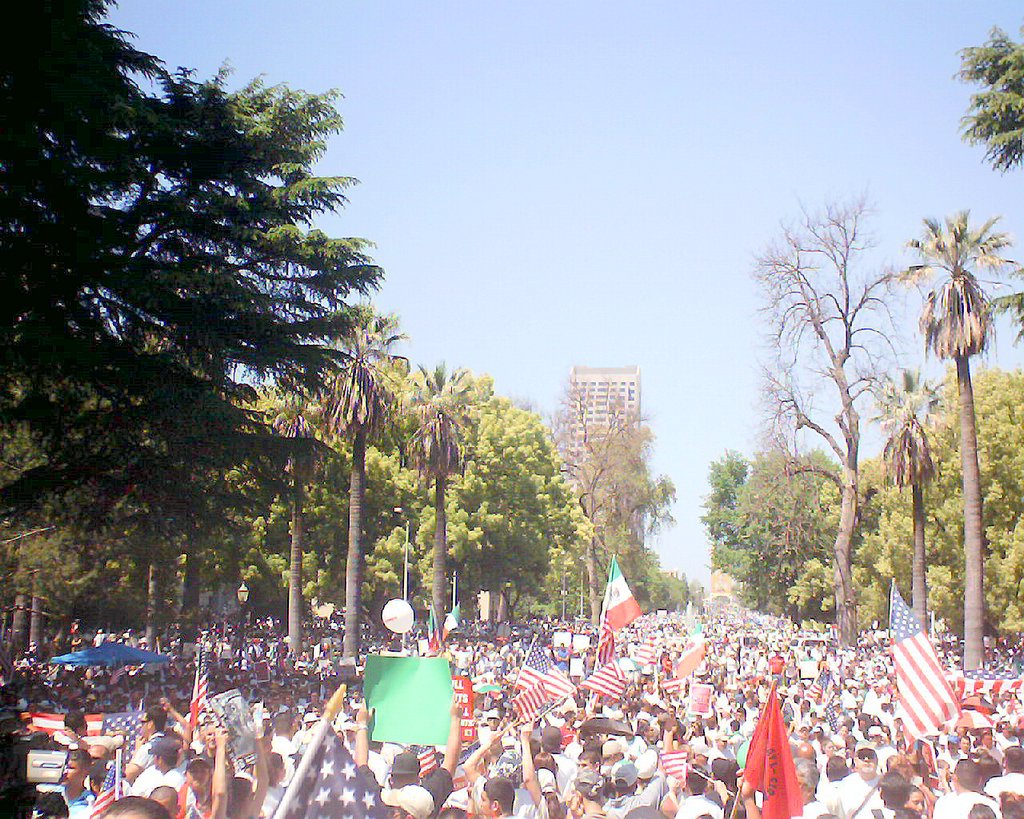
May Day 2006: Sacramento, California
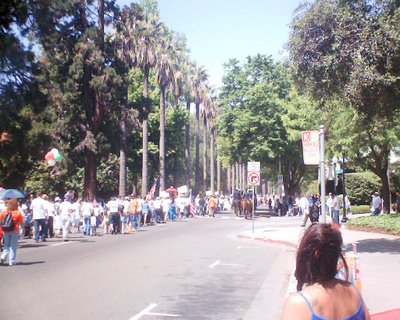
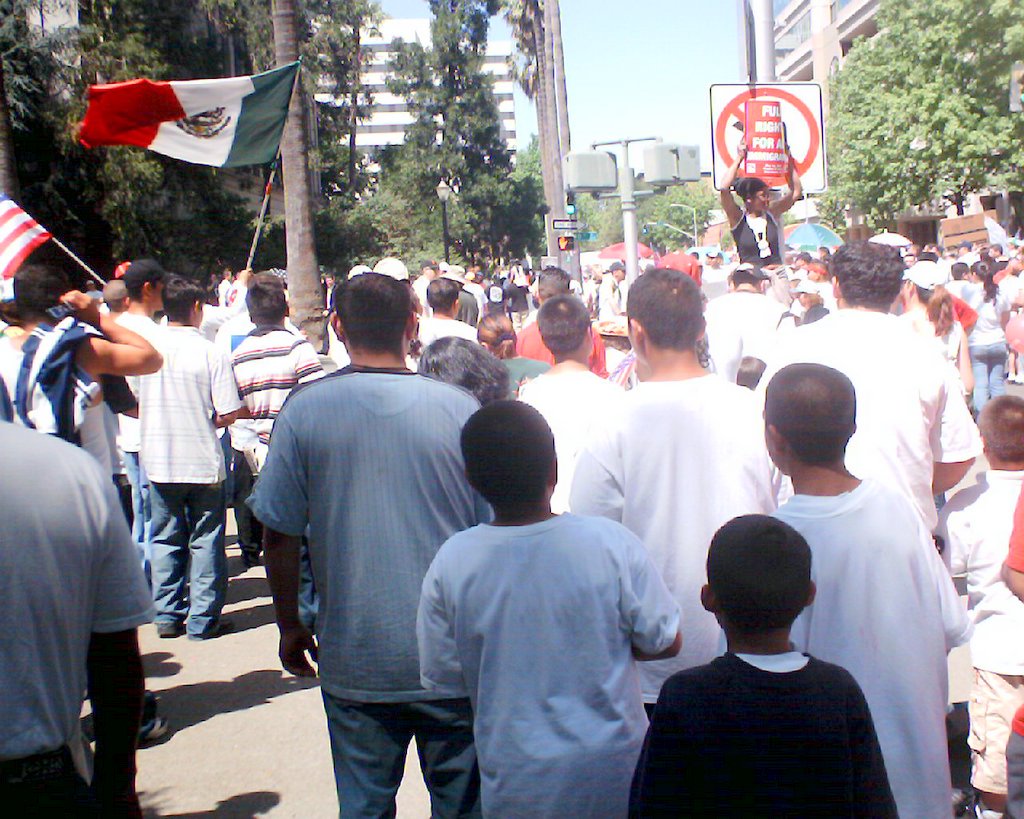
TOP: La Raza Cosmica Marching east on 'L' Street...
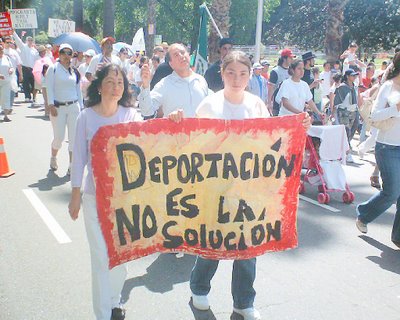
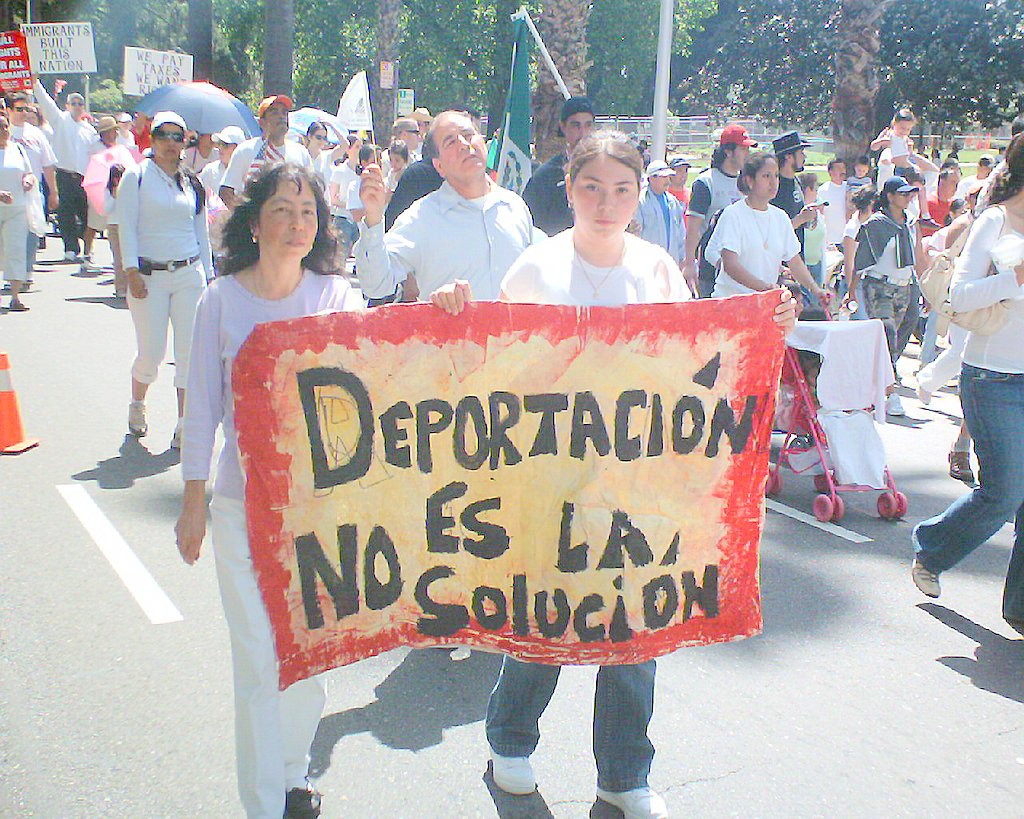
NEXT: A couple of Companeras holding a good banner that says:
Deportacon No Es La Solucion"
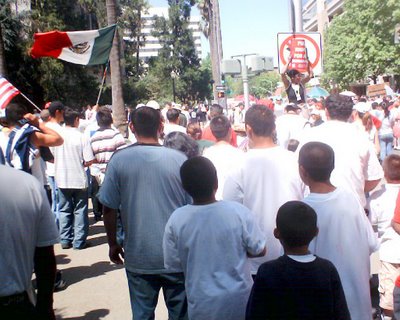
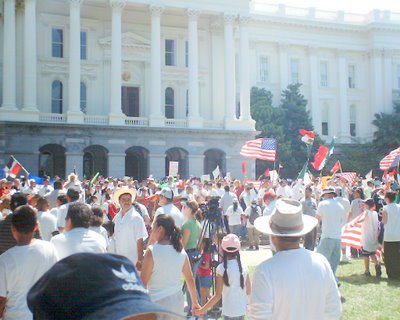
THEN: Gente gathering by the corner of 10th and 'L' Streets...
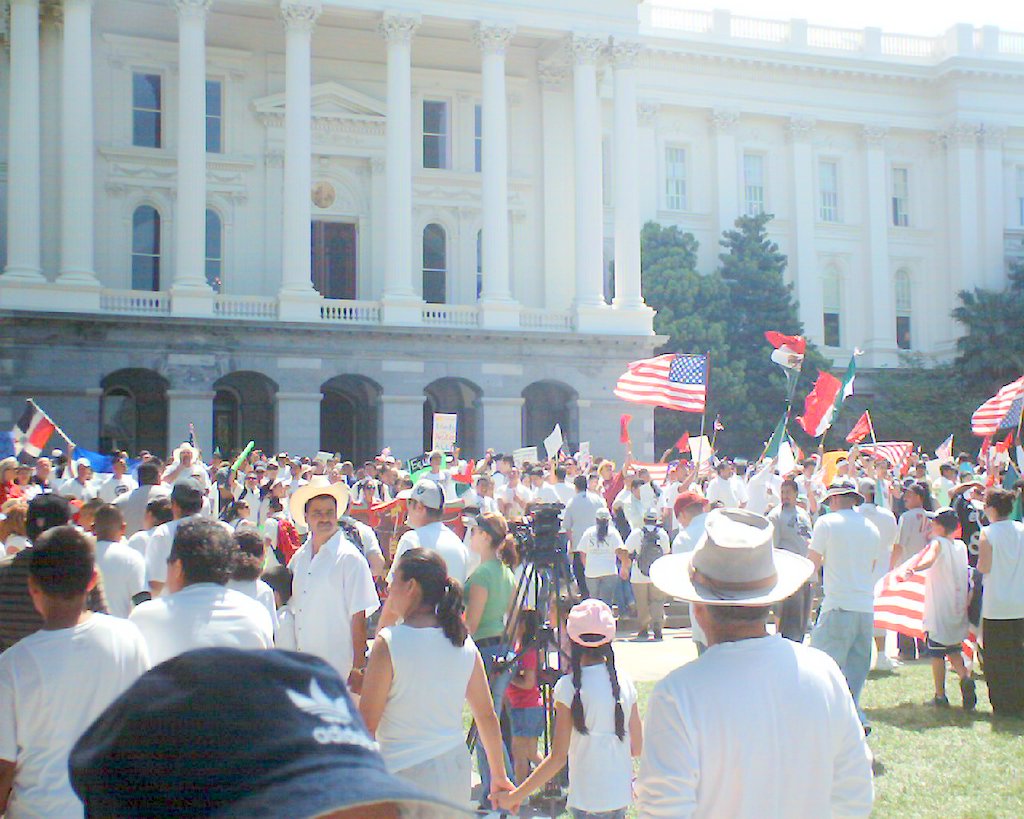
NEXT: People gathering at the steps of the State Capitol

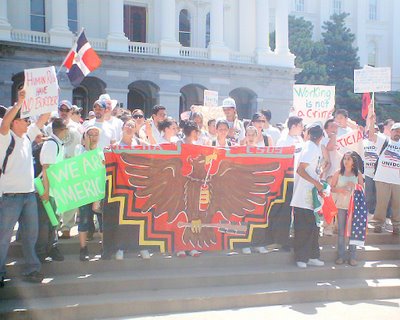
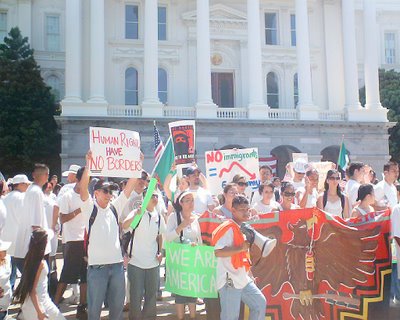
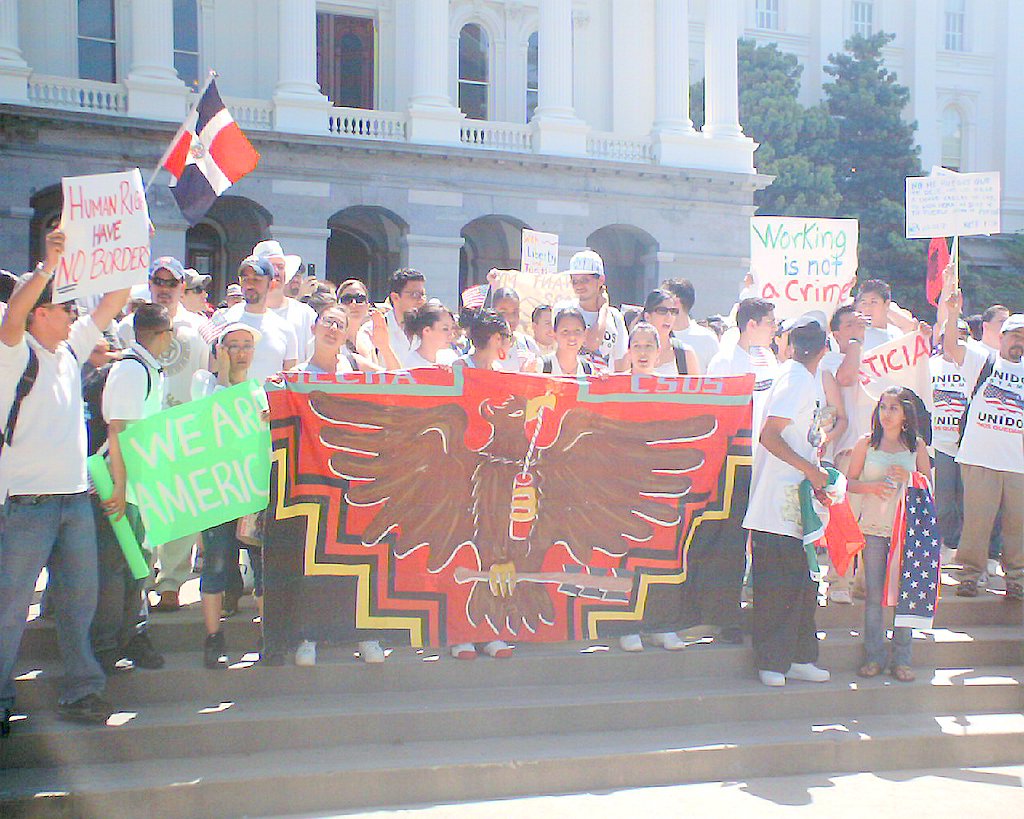
NEXT: Picture of the MECHA Emblem... being held by Mechistas...
THEN: Shouts of Si Se Puede! filled the air in front of the California State Capitol Building with a good sign that reads "Human Rights Have No Borders!"
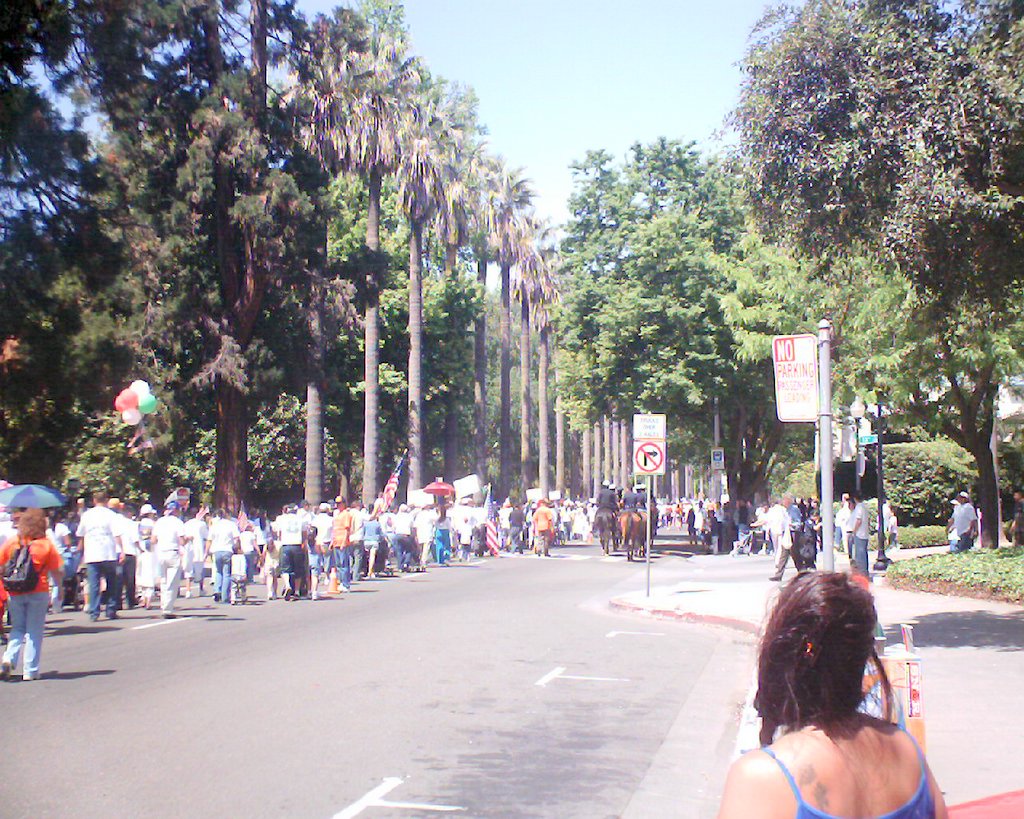
NEXT: A good picture of the thousands of La Raza Cosmica still pouring towards the State Capitol today facing east towards the Tower Bridge from the steps of the State Capitol!...
BOTTOM: A raised fist showing both the United States and Mexican Flags!

++++++++++
Humane-Rights-Agenda Blog
++++++++++


c/s
++++++++++
NEXT: A couple of Companeras holding a good banner that says:
Deportacon No Es La Solucion"
THEN: Gente gathering by the corner of 10th and 'L' Streets...
NEXT: People gathering at the steps of the State Capitol
NEXT: Picture of the MECHA Emblem... being held by Mechistas...
THEN: Shouts of Si Se Puede! filled the air in front of the California State Capitol Building with a good sign that reads "Human Rights Have No Borders!"
NEXT: A good picture of the thousands of La Raza Cosmica still pouring towards the State Capitol today facing east towards the Tower Bridge from the steps of the State Capitol!...
BOTTOM: A raised fist showing both the United States and Mexican Flags!

++++++++++
Humane-Rights-Agenda Blog
++++++++++
c/s
++++++++++
NNIRR Statement:
Fair and Just Immigration Reform for All: April 2006
http://www.nnirr.org/projects/immigrationreform/statement.htm

Immigration Reform
List of Endorsers / En espanol
National Statement to Support Human and Civil Rights for All Immigrants And to Oppose Compromise Immigration Reform Proposals
Fair and Just Immigration Reform for All: April 2006
We stand together as immigrant, faith, social justice, labor, peace, human and civil rights organizations and other concerned communities to support human and civil rights for all immigrants and to oppose the immigration “reform” proposals presently in the U.S. Senate. We oppose H.R. 4437, the immigration bill passed in the House of Representatives in December, as well as all of the compromise bills presented in the Senate.
We call upon members of Congress and the Administration to stop masquerading these proposals as immigration reform. We demand nothing less than immigration policies that are fair and just, and that respect the rights and dignity of all immigrants and other members of our society.
The rush to reach a bipartisan accord on immigration legislation has led to a compromise that would create deep divisions within the immigrant community and leave millions of undocumented immigrants in the shadows of our country. We oppose the behind-the-scenes brokering currently playing out in the legislative process. These trade-offs and deals are based on election-year campaigning and demands by business lobbyists, rather than on the best interests and voices of immigrant communities. We say, “No deal!”
In a re-ignited civil rights movement, millions of immigrants, their families, neighbors and co-workers, along with faith and labor leaders, peace and justice advocates, have marched and rallied in cities across the U.S. The mobilizations have served as a wake-up call for the whole country to acknowledge the vital role of immigrants as co-workers, neighbors and members of our broad society. And, as details of the current legislative compromise have become known, the voices of immigrant communities are rejecting the proposals for a so-called legalization program, and are denouncing the further erosion of human and civil rights through the enforcement and criminalization provisions. The stakes are considerable, and affect all of us.
This year is the 20th anniversary of the 1986 legalization and employer sanctions law, and the 10th anniversary of the restrictive Illegal Immigration Reform and Immigrant Responsibility Act. We cannot allow the current proposals to be enacted as this generation’s flawed immigration reform legacy.
What We Want: Fair and Just Immigration Reform
Fair and just immigration reform means:
* Genuine legalization and opportunities to adjust status for all undocumented immigrants, including youth and farmworkers
* Preservation of due process, including restoration of access to the courts and meaningful judicial review for immigrants.
* No indefinite detention or expansion of mandatory detention
* No expansion of guest worker programs
* No more wasted resources allocated to further militarize our borders and that contribute to the crisis of human rights and lives in the border regions
* An end to employer sanctions and electronic worker verification systems
* The strengthening and enforcement of labor law protections for all workers, native and foreign born
* No use of city, state or other government agencies in the enforcement of immigration law
* No more criminalization of immigrants, or their service providers
* Expansion of legal immigration opportunities, support for family reunification and immediate processing of the backlog of pending visa applications
* Elimination of harsh obstacles to immigrating, including the HIV ban, “3 and 10 year bars,” and high income requirements for immigrant sponsors.
The Current ‘Legalization’ Proposal is Unacceptable
The proposed 3-tiered temporary worker program offers little hope for broad, inclusive legalization of undocumented immigrants. What some are calling a “path to citizenship” in the last Senate bill is merely a massive temporary worker program without worker protections, and contains numerous hurdles that will drastically limit the number of undocumented immigrants who can actually legalize. Such a program would divide communities, including mixed-status families, erode wage and benefits standards, and place a greater burden on safety-net services.
The Enforcement Proposals Undermine All of our Rights
Significant provisions in the current Senate proposals would dramatically undermine a broad array of rights, increase the criminalization of all immigrants, result in mass deportations, and unfairly exclude millions from eligibility for any legalization opportunity. The expansion of expedited removal would eliminate the right to a court hearing, while the broadened definition of “aggravated felony” to include many minor offenses would result in mandatory detention and mass deportations. The proposals also seek to reinstate indefinite detention and increase detention facilities, including the use of closed military bases. Encouraging local police to enforce immigration law would not only add an additional burden that detracts from current responsibilities, but would discourage immigrant access to public safety institutions.
Moreover, the increased resources to militarize the border, which has already cost over $30 billion in the past 12 years, has not deterred unauthorized border crossings and instead has caused a humanitarian crisis with the deaths of some 4,000 people in the desert. Current border enforcement policies, laws and practices, without provision for safe and legal entry, have resulted in the detention and criminalization of tens of thousands of people at a significant daily cost to taxpayers.
The Proposals Fail to Protect Workers
The current proposals would further erode already weak labor protections and rights for immigrants and other workers. Immigrant workers have historically been used as “cheap labor” by employers and industries unwilling to pay decent wages or to maintain reasonable working conditions. These proposals continue in that same shameful vein, and are designed to force and keep wages down to compete with cheap labor suppliers globally.
Workers need more, not less, rights. A real legalization proposal needs to be coupled with the repeal of employer sanctions, the provision of the landmark 1986 Immigration Reform and Control Act that has led to the criminalization of immigrant workers, and which would be deepened through an expansion of an employment verification system. This program has done nothing in the last twenty years but increase discrimination and abuse of immigrant workers.
Employers have had greater leverage to threaten and intimidate immigrant workers, break organizing efforts, carry out unjust firings, and lower wages and work conditions for all working people. These abuses impact the entire American workforce, particularly the most vulnerable toiling in low-wage jobs such as farmworkers, day laborers and domestic workers.
No Expansion of Guest Worker Programs
A key concern is the significant expansion of guest worker programs found in almost all Senate proposals and supported by the Administration. We oppose these programs both when they are tied to legalization for undocumented immigrants already living and working here, and as a means for managing future flows of immigrants into the United States. The U.S. does not have a shortage of workers; what we have is a shortage of employers willing to pay a living wage and maintain decent working conditions.
Guest worker programs have been condemned by labor and immigrant communities for their long record of violations of labor rights and standards, including blacklists and deportations of workers who protest. In 1964, Ernesto Galarza, Cesar Chavez and other defenders of workplace rights won the abolition of the old Bracero guest worker program. The purpose of that program, they said, was the creation a vulnerable workforce in order to drive down wages and break union organizing efforts among immigrants and non-immigrants alike. The purpose of current proposals is the same. Temporary, contract workers are prevented the option of putting down roots and becoming full and equal members of our communities.
Future migrants should not be forced to accept a second-class status, violating our country's most basic commitments to equality. They should be given permanent residence status, allowing them to work and travel freely, to exercise their labor rights, and to live as any other member of our society.
No Compromise, No Deal on Fair and Just Immigration Reform
In recent years, immigrant community members, including youth and students, farmworkers and others, have effectively organized and rallied in support of legislative proposals to strengthen their rights and opportunities to be equal members of this society. Despite the loud and determined voice of immigrant communities, advocates and supporters for fair and just immigration reform this year, we have yet to see an acceptable proposal from Congress. And with H.R. 4437 already passed by the House, we are very aware that any proposal from the Senate would be subject to further compromise in a Senate-House reconciliation process, and would likely produce laws that would detrimentally affect current and future immigrants for years to come.
Increased enforcement does not address the complex issue of global migration. Employer sanctions and beefed up border security have been in place for decades as deterrents to migration, and yet the number of undocumented continues to grow. The sources of migration rest in the problems of economic and political instability, poverty and war in migrant-sending countries.
Despite the urgency of the immigration issue in this country, it is clearly not just a “domestic” issue and our policies need to consider support for economic stability, fair trade agreements and peace as vital to addressing the migration of people in search of work, survival, and safety.
We will continue to raise our voices for genuine immigration reform that respects the rights and dignity of all immigrants, and is fair and just. Immigrant workers, students and families are making incredible sacrifices to raise their voices for themselves and future generations, in the face of recriminations and disciplinary actions from employers and schools. As immigrant communities continue to mobilize for their rights, on May 1 and beyond, we will support their right and choice to express themselves.
We pledge to increase public education efforts and the building and mobilization of meaningful alliances, and we will encourage and support immigrant community leadership to advance real immigration reform. We call upon Congress and the Administration to heed the voices of immigrant communities demanding genuine immigration reforms: real legalization, equitable inclusion in our society, justice, and respect for human rights.
LIST OF ENDORSERS
To endorse this statement, please fill out this form.
Organizational Endorsers (As of April 27, 2006)
Access California Services (Anaheim, CA)
Adhikaar (Staten Island, NY)
AFL-CIO (Washington, DC)
Alliance of South Asians Taking Action (ASATA) (Oakland, CA)
American-Arab Anti-Discrimination Committee -- Massachusetts Chapter (Boston, MA)
American Friends Service Committee-Austin (Austin, TX)
American Friends Service Committee (AFSC) (Philadelphia, PA)
Arab American Family Support Center (Brooklyn, NY)
Arab Community Center for Economic and Social Services (ACCESS) (Dearborn, MI)
Asian Immigrant Women Advocates (Oakland, CA)
Asian Pacific Environmental Network (Oakland, CA)
Asociacion Latina (Clarksville, TN)
Aztlan Media Kollective (East Los Angeles & San Francisco, CA)
Audre Lorde Project (New York, NY)
Bonilla Community Services (Durham, NC)
Border Agricultural Workers Project (El Paso, TX)
Building Opportunities for Self-Sufficiency (Berkeley, CA)
Black Workers for Justice (North Carolina)
CAAAV Organizing Asian Communities (New York, NY)
CASA Latina (Seattle, WA)
Center for Constitutional Rights (New York, NY)
Center for Immigrant Families (New York, NY)
Central Valley Progressive PAC (Fresno, CA)
CENTRO HISPANO "Cuzcatlán" (Jamaica, NY)
CAA: Chinese for Affirmative Action/Center for Asian American Advocacy (San Francisco, CA)
Chicano Consortium (Sacramento, CA)
Chinese Progressive Association (San Francisco, CA)
Coalición de Derechos Humanos (Tucson, AZ)
Coalición de Trabajadores de Immokalee (Immokalee, FL)
Comite NO NOS VAMOS (Fresno, CA)
Community HIV/AIDS Mobilization Project (CHAMP) (Providence, RI)
Desis Rising Up & Moving (DRUM) (New York, NY)
Eastern Massachusetts Jobs with Justice
Esperanza Peace and Justice Center (San Antonio, TX)
Farmworker Legal Services of NY, Inc. (Rochester, NY)
Filipinos for Affirmative Action (Oakland, CA)
Filipino Civil Rights Advocates (FilCRA) (Oakland, CA)
Frente Continental (Los Angeles, CA)
Frente Indígena de Organizaciones Binacionales (FIOB) (Fresno, CA)
Fuerza Unida (San Antonio, TX)
Gay Men’s Health Crisis (New York, NY)
Gente Unida/San Diego Border Coalition for Human Rights (Chula Vista, CA)
Gustavus Myers Center for the Study of Bigotry and Human Rights (Boston, MA)
Health Initiatives for Youth (San Francisco, CA)
Hispanic Organizations Leadership Alliance (Washington, DC)
Iglesia San Romero de Las Americas-UCC (New York, NY)
Iglesia Metodista Unida Summerfield (New York, NY)
Immigrant Communities in Action (New York, NY)
Immigrant Justice Solidarity Project (Brooklyn, NY)
Immigration Equality (New York, NY)
Inmigrantes Latinos en Accion (Austin, TX)
Jews for Racial and Economic Justice (New York, NY)
Junta Centro Mujer Dominicana (New York, NY)
Korean Americans United For Peace (Bay Area, CA)
Korean Community Center of the East Bay (Oakland, CA)
Korean Immigrant Workers Alliance (KIWA), (Los Angeles, CA)
Korean Youth Cultural Center (Oakland, CA)
La Raza Centro Legal, SF Day Labor Program (San Francisco, CA)
Labor Council for Latin American Advancement--Massachusetts Chapter
Latino Union of Chicago (Chicago, IL)
Los Angeles Coalition to End Hunger and Homelessness (Los Angeles, CA)
Migrant Worker Solidarity of Douglas County (Eudora, KS)
Migration Policy & Resource Center/Occidental College (Los Angeles, CA)
National Association of People with AIDS (NAPWA) (Silver Spring, MD)
National Immigration Project of the National Lawyers Guild (Boston, MA)
National Network for Arab American Communities (NNAAC)
National Network for Immigrant and Refugee Rights (Oakland, CA)
North Carolina Justice Center (Durham, NC)
Nuestra Casa (East Palo Alto, CA)
Orange County Peace & Freedom Party (Anaheim, CA)
The Oakland Institute (Oakland, CA)
Peace and Freedom Party
Peace and Freedom Party of Fresno County (Clovis, CA)
Pilipino Workers Center of Southern California (Los Angeles, CA)
Project Voice New England -- American Friends Service Committee (Boston, MA)
San Francisco Day Labor Program Women’s Collective of La Raza Centro Legal (San Francisco, CA)
Section of Christian Social Responsibility, Women’s Division, United Methodist Church (New York, NY
Southwest Network for Environmental and Economic Justice (Albuquerque, NM)
Southwest Organizing Project (Albuquerque, NM)
Southwest Workers' Union (San Antonio, TX)
South Asian Network (Artesia, CA)
Speak Out - The Institute for Democratic Education and Culture (Emeryville, CA)
Student/Farmworker Alliance (Immokalee, FL)
The Applied Research Center (Oakland, CA)
ThinkingPeople (Mount Pleasant, SC)
Third World Majority (Oakland, CA)
United for a Fair Economy (Boston, MA)
UP (United Progressives) for Democracy, Hip Hop Caucus, Cities for Progress, Gulf Coast Renewal Campaign (Washington, DC)
US-Mexico Border Program / American Friends Service Committee (San Diego, CA)
Voluntarios de la Comunidad (Sacramento, CA)
War Times/Tiempo de Guerras (Emeryville, CA)
WILD for Human Rights (San Francisco, CA)
Women’s International League for Peace & Freedom -- Fresno Branch (Fresno, CA)
International Endorsers
Asian Migrant Centre (Hong Kong)
Asia Pacific Mission for Migrants (APMM) (Hong Kong)
Labour, Health and Human Rights Development Centre (Lagos, Nigeria)
Migrant Forum Asia (Manila, Philippines)
Migrant Rights International (Geneva, Switzerland)
++++++++++++++++++++
Humane-Rights-Agenda Blog
Join Humane-Rights-Agenda Yahoo Group!
Related Blogs:
De Tod@as Para Tod@as Blog
Native Resistance Blog!
++++++++++++++++++
c/s
+++++++++++++++++

Immigration Reform
List of Endorsers / En espanol
National Statement to Support Human and Civil Rights for All Immigrants And to Oppose Compromise Immigration Reform Proposals
Fair and Just Immigration Reform for All: April 2006
We stand together as immigrant, faith, social justice, labor, peace, human and civil rights organizations and other concerned communities to support human and civil rights for all immigrants and to oppose the immigration “reform” proposals presently in the U.S. Senate. We oppose H.R. 4437, the immigration bill passed in the House of Representatives in December, as well as all of the compromise bills presented in the Senate.
We call upon members of Congress and the Administration to stop masquerading these proposals as immigration reform. We demand nothing less than immigration policies that are fair and just, and that respect the rights and dignity of all immigrants and other members of our society.
The rush to reach a bipartisan accord on immigration legislation has led to a compromise that would create deep divisions within the immigrant community and leave millions of undocumented immigrants in the shadows of our country. We oppose the behind-the-scenes brokering currently playing out in the legislative process. These trade-offs and deals are based on election-year campaigning and demands by business lobbyists, rather than on the best interests and voices of immigrant communities. We say, “No deal!”
In a re-ignited civil rights movement, millions of immigrants, their families, neighbors and co-workers, along with faith and labor leaders, peace and justice advocates, have marched and rallied in cities across the U.S. The mobilizations have served as a wake-up call for the whole country to acknowledge the vital role of immigrants as co-workers, neighbors and members of our broad society. And, as details of the current legislative compromise have become known, the voices of immigrant communities are rejecting the proposals for a so-called legalization program, and are denouncing the further erosion of human and civil rights through the enforcement and criminalization provisions. The stakes are considerable, and affect all of us.
This year is the 20th anniversary of the 1986 legalization and employer sanctions law, and the 10th anniversary of the restrictive Illegal Immigration Reform and Immigrant Responsibility Act. We cannot allow the current proposals to be enacted as this generation’s flawed immigration reform legacy.
What We Want: Fair and Just Immigration Reform
Fair and just immigration reform means:
* Genuine legalization and opportunities to adjust status for all undocumented immigrants, including youth and farmworkers
* Preservation of due process, including restoration of access to the courts and meaningful judicial review for immigrants.
* No indefinite detention or expansion of mandatory detention
* No expansion of guest worker programs
* No more wasted resources allocated to further militarize our borders and that contribute to the crisis of human rights and lives in the border regions
* An end to employer sanctions and electronic worker verification systems
* The strengthening and enforcement of labor law protections for all workers, native and foreign born
* No use of city, state or other government agencies in the enforcement of immigration law
* No more criminalization of immigrants, or their service providers
* Expansion of legal immigration opportunities, support for family reunification and immediate processing of the backlog of pending visa applications
* Elimination of harsh obstacles to immigrating, including the HIV ban, “3 and 10 year bars,” and high income requirements for immigrant sponsors.
The Current ‘Legalization’ Proposal is Unacceptable
The proposed 3-tiered temporary worker program offers little hope for broad, inclusive legalization of undocumented immigrants. What some are calling a “path to citizenship” in the last Senate bill is merely a massive temporary worker program without worker protections, and contains numerous hurdles that will drastically limit the number of undocumented immigrants who can actually legalize. Such a program would divide communities, including mixed-status families, erode wage and benefits standards, and place a greater burden on safety-net services.
The Enforcement Proposals Undermine All of our Rights
Significant provisions in the current Senate proposals would dramatically undermine a broad array of rights, increase the criminalization of all immigrants, result in mass deportations, and unfairly exclude millions from eligibility for any legalization opportunity. The expansion of expedited removal would eliminate the right to a court hearing, while the broadened definition of “aggravated felony” to include many minor offenses would result in mandatory detention and mass deportations. The proposals also seek to reinstate indefinite detention and increase detention facilities, including the use of closed military bases. Encouraging local police to enforce immigration law would not only add an additional burden that detracts from current responsibilities, but would discourage immigrant access to public safety institutions.
Moreover, the increased resources to militarize the border, which has already cost over $30 billion in the past 12 years, has not deterred unauthorized border crossings and instead has caused a humanitarian crisis with the deaths of some 4,000 people in the desert. Current border enforcement policies, laws and practices, without provision for safe and legal entry, have resulted in the detention and criminalization of tens of thousands of people at a significant daily cost to taxpayers.
The Proposals Fail to Protect Workers
The current proposals would further erode already weak labor protections and rights for immigrants and other workers. Immigrant workers have historically been used as “cheap labor” by employers and industries unwilling to pay decent wages or to maintain reasonable working conditions. These proposals continue in that same shameful vein, and are designed to force and keep wages down to compete with cheap labor suppliers globally.
Workers need more, not less, rights. A real legalization proposal needs to be coupled with the repeal of employer sanctions, the provision of the landmark 1986 Immigration Reform and Control Act that has led to the criminalization of immigrant workers, and which would be deepened through an expansion of an employment verification system. This program has done nothing in the last twenty years but increase discrimination and abuse of immigrant workers.
Employers have had greater leverage to threaten and intimidate immigrant workers, break organizing efforts, carry out unjust firings, and lower wages and work conditions for all working people. These abuses impact the entire American workforce, particularly the most vulnerable toiling in low-wage jobs such as farmworkers, day laborers and domestic workers.
No Expansion of Guest Worker Programs
A key concern is the significant expansion of guest worker programs found in almost all Senate proposals and supported by the Administration. We oppose these programs both when they are tied to legalization for undocumented immigrants already living and working here, and as a means for managing future flows of immigrants into the United States. The U.S. does not have a shortage of workers; what we have is a shortage of employers willing to pay a living wage and maintain decent working conditions.
Guest worker programs have been condemned by labor and immigrant communities for their long record of violations of labor rights and standards, including blacklists and deportations of workers who protest. In 1964, Ernesto Galarza, Cesar Chavez and other defenders of workplace rights won the abolition of the old Bracero guest worker program. The purpose of that program, they said, was the creation a vulnerable workforce in order to drive down wages and break union organizing efforts among immigrants and non-immigrants alike. The purpose of current proposals is the same. Temporary, contract workers are prevented the option of putting down roots and becoming full and equal members of our communities.
Future migrants should not be forced to accept a second-class status, violating our country's most basic commitments to equality. They should be given permanent residence status, allowing them to work and travel freely, to exercise their labor rights, and to live as any other member of our society.
No Compromise, No Deal on Fair and Just Immigration Reform
In recent years, immigrant community members, including youth and students, farmworkers and others, have effectively organized and rallied in support of legislative proposals to strengthen their rights and opportunities to be equal members of this society. Despite the loud and determined voice of immigrant communities, advocates and supporters for fair and just immigration reform this year, we have yet to see an acceptable proposal from Congress. And with H.R. 4437 already passed by the House, we are very aware that any proposal from the Senate would be subject to further compromise in a Senate-House reconciliation process, and would likely produce laws that would detrimentally affect current and future immigrants for years to come.
Increased enforcement does not address the complex issue of global migration. Employer sanctions and beefed up border security have been in place for decades as deterrents to migration, and yet the number of undocumented continues to grow. The sources of migration rest in the problems of economic and political instability, poverty and war in migrant-sending countries.
Despite the urgency of the immigration issue in this country, it is clearly not just a “domestic” issue and our policies need to consider support for economic stability, fair trade agreements and peace as vital to addressing the migration of people in search of work, survival, and safety.
We will continue to raise our voices for genuine immigration reform that respects the rights and dignity of all immigrants, and is fair and just. Immigrant workers, students and families are making incredible sacrifices to raise their voices for themselves and future generations, in the face of recriminations and disciplinary actions from employers and schools. As immigrant communities continue to mobilize for their rights, on May 1 and beyond, we will support their right and choice to express themselves.
We pledge to increase public education efforts and the building and mobilization of meaningful alliances, and we will encourage and support immigrant community leadership to advance real immigration reform. We call upon Congress and the Administration to heed the voices of immigrant communities demanding genuine immigration reforms: real legalization, equitable inclusion in our society, justice, and respect for human rights.
LIST OF ENDORSERS
To endorse this statement, please fill out this form.
Organizational Endorsers (As of April 27, 2006)
Access California Services (Anaheim, CA)
Adhikaar (Staten Island, NY)
AFL-CIO (Washington, DC)
Alliance of South Asians Taking Action (ASATA) (Oakland, CA)
American-Arab Anti-Discrimination Committee -- Massachusetts Chapter (Boston, MA)
American Friends Service Committee-Austin (Austin, TX)
American Friends Service Committee (AFSC) (Philadelphia, PA)
Arab American Family Support Center (Brooklyn, NY)
Arab Community Center for Economic and Social Services (ACCESS) (Dearborn, MI)
Asian Immigrant Women Advocates (Oakland, CA)
Asian Pacific Environmental Network (Oakland, CA)
Asociacion Latina (Clarksville, TN)
Aztlan Media Kollective (East Los Angeles & San Francisco, CA)
Audre Lorde Project (New York, NY)
Bonilla Community Services (Durham, NC)
Border Agricultural Workers Project (El Paso, TX)
Building Opportunities for Self-Sufficiency (Berkeley, CA)
Black Workers for Justice (North Carolina)
CAAAV Organizing Asian Communities (New York, NY)
CASA Latina (Seattle, WA)
Center for Constitutional Rights (New York, NY)
Center for Immigrant Families (New York, NY)
Central Valley Progressive PAC (Fresno, CA)
CENTRO HISPANO "Cuzcatlán" (Jamaica, NY)
CAA: Chinese for Affirmative Action/Center for Asian American Advocacy (San Francisco, CA)
Chicano Consortium (Sacramento, CA)
Chinese Progressive Association (San Francisco, CA)
Coalición de Derechos Humanos (Tucson, AZ)
Coalición de Trabajadores de Immokalee (Immokalee, FL)
Comite NO NOS VAMOS (Fresno, CA)
Community HIV/AIDS Mobilization Project (CHAMP) (Providence, RI)
Desis Rising Up & Moving (DRUM) (New York, NY)
Eastern Massachusetts Jobs with Justice
Esperanza Peace and Justice Center (San Antonio, TX)
Farmworker Legal Services of NY, Inc. (Rochester, NY)
Filipinos for Affirmative Action (Oakland, CA)
Filipino Civil Rights Advocates (FilCRA) (Oakland, CA)
Frente Continental (Los Angeles, CA)
Frente Indígena de Organizaciones Binacionales (FIOB) (Fresno, CA)
Fuerza Unida (San Antonio, TX)
Gay Men’s Health Crisis (New York, NY)
Gente Unida/San Diego Border Coalition for Human Rights (Chula Vista, CA)
Gustavus Myers Center for the Study of Bigotry and Human Rights (Boston, MA)
Health Initiatives for Youth (San Francisco, CA)
Hispanic Organizations Leadership Alliance (Washington, DC)
Iglesia San Romero de Las Americas-UCC (New York, NY)
Iglesia Metodista Unida Summerfield (New York, NY)
Immigrant Communities in Action (New York, NY)
Immigrant Justice Solidarity Project (Brooklyn, NY)
Immigration Equality (New York, NY)
Inmigrantes Latinos en Accion (Austin, TX)
Jews for Racial and Economic Justice (New York, NY)
Junta Centro Mujer Dominicana (New York, NY)
Korean Americans United For Peace (Bay Area, CA)
Korean Community Center of the East Bay (Oakland, CA)
Korean Immigrant Workers Alliance (KIWA), (Los Angeles, CA)
Korean Youth Cultural Center (Oakland, CA)
La Raza Centro Legal, SF Day Labor Program (San Francisco, CA)
Labor Council for Latin American Advancement--Massachusetts Chapter
Latino Union of Chicago (Chicago, IL)
Los Angeles Coalition to End Hunger and Homelessness (Los Angeles, CA)
Migrant Worker Solidarity of Douglas County (Eudora, KS)
Migration Policy & Resource Center/Occidental College (Los Angeles, CA)
National Association of People with AIDS (NAPWA) (Silver Spring, MD)
National Immigration Project of the National Lawyers Guild (Boston, MA)
National Network for Arab American Communities (NNAAC)
National Network for Immigrant and Refugee Rights (Oakland, CA)
North Carolina Justice Center (Durham, NC)
Nuestra Casa (East Palo Alto, CA)
Orange County Peace & Freedom Party (Anaheim, CA)
The Oakland Institute (Oakland, CA)
Peace and Freedom Party
Peace and Freedom Party of Fresno County (Clovis, CA)
Pilipino Workers Center of Southern California (Los Angeles, CA)
Project Voice New England -- American Friends Service Committee (Boston, MA)
San Francisco Day Labor Program Women’s Collective of La Raza Centro Legal (San Francisco, CA)
Section of Christian Social Responsibility, Women’s Division, United Methodist Church (New York, NY
Southwest Network for Environmental and Economic Justice (Albuquerque, NM)
Southwest Organizing Project (Albuquerque, NM)
Southwest Workers' Union (San Antonio, TX)
South Asian Network (Artesia, CA)
Speak Out - The Institute for Democratic Education and Culture (Emeryville, CA)
Student/Farmworker Alliance (Immokalee, FL)
The Applied Research Center (Oakland, CA)
ThinkingPeople (Mount Pleasant, SC)
Third World Majority (Oakland, CA)
United for a Fair Economy (Boston, MA)
UP (United Progressives) for Democracy, Hip Hop Caucus, Cities for Progress, Gulf Coast Renewal Campaign (Washington, DC)
US-Mexico Border Program / American Friends Service Committee (San Diego, CA)
Voluntarios de la Comunidad (Sacramento, CA)
War Times/Tiempo de Guerras (Emeryville, CA)
WILD for Human Rights (San Francisco, CA)
Women’s International League for Peace & Freedom -- Fresno Branch (Fresno, CA)
International Endorsers
Asian Migrant Centre (Hong Kong)
Asia Pacific Mission for Migrants (APMM) (Hong Kong)
Labour, Health and Human Rights Development Centre (Lagos, Nigeria)
Migrant Forum Asia (Manila, Philippines)
Migrant Rights International (Geneva, Switzerland)
++++++++++++++++++++
Humane-Rights-Agenda Blog
Join Humane-Rights-Agenda Yahoo Group!
Related Blogs:
De Tod@as Para Tod@as Blog
Native Resistance Blog!
++++++++++++++++++
c/s
+++++++++++++++++
Sunday, April 30, 2006
Immigrant Rights Report:
Sunday, April 30, 2006
http://humane-rights-agenda.blogspot.com/2006/04/immigrant-rights-reportsunday-april-30.html
zzzzzzzzzzzzzzzzzzzzzzzzzzzzzzzzzzzzzzzzzzzzzzzzzzzapata
http://www.politicalaffairs.net/article/articleview/3327/1/163/
Why We Fight for Immigrant Rights =4-30-06, 10:06 am
By John J. Sweeney is President of the AFL-CIO
Many workers—union and nonunion—ask why unions support a path to citizenship for undocumented immigrants. Why, as one member puts it, are we fighting for the "illegals who have been taking our jobs"?
I remind them of a powerful statement from labor’s past that lives on today: An injury to one is an injury to all.
America’s broken immigration system has allowed employers to create a low-wage labor pool of immigrant workers that is easily exploitable. Employers can pay these workers less, force them to work in intolerable conditions, block their right to union representation and threaten to turn them in to immigration officials if they complain. That’s immoral.
And when employers drive down wages and working conditions for one group of workers, they harm us all. That’s not progressive rhetoric—it’s cold, hard truth. U.S.-born workers who work alongside immigrants and in the same industries suffer the same exploitation. The U.S. Department of Labor, for example, has found the poultry industry—with a workforce split about evenly between African Americans and immigrants—was 100 percent out of compliance with federal wage and hour laws. More than half of the country’s garment factories violate wage and hour laws and more than three- quarters violate health and safety laws, according to the department. If a workplace is dangerous for immigrant workers, it is equally dangerous for their U.S.-born co- workers.
Some people say we could solve this by simply keeping immigrants out of the country. But America is a nation of immigrants, made up almost entirely of European, African, Asian and South and Central American brothers and sisters who came here in previous waves of migration. Some 12 million undocumented immigrants are here today—that’s reality—and they are working and paying taxes and strengthening our economy and our culture. Here’s more reality: Globalization is not going away. Employers will do all they can to fill the jobs that can’t be exported to low-wage countries by importing low-wage workers with no ability to exercise their rights. The genie of the globalized economy is not going back into the bottle.
The answer isn’t to make immigrant workers here now disappear, or turn them into felons, as the bill passed by the Republican majority in the U.S. House of Representatives would do. The answer is to deprive employers of the means to exploit them and lower work quality for all of us. As long as immigrant workers can be terrorized by the threat of deportation or prosecution based on their status, employers can control and abuse them. But 12 million immigrant workers with the power and rights of citizenship would be vital partners with U.S. born workers in the fight for living wages, health and retirement benefits and justice on the job.
And the answer isn’t guest worker programs that U.S. employers use to turn permanent jobs that pay well into temporary jobs that offer few or no benefits, pay lower wages and chain workers to the employers that recruited them, making them vulnerable to exploitation.
Again and again employers say they need immigrant workers because U.S.-born workers won’t do the jobs. But you and I know darn well it’s slave wages U.S. workers are rejecting, not the jobs themselves.
I believe deeply that immigrant workers are our sisters and brothers and that every person who works in this country is entitled to the full range of rights and opportunities America provides. We must support immigrant workers because supporting all working people is the core of what it means to be a trade unionist. We are always—always—stronger together than when we allow ruthless employers and the politicians they own to drive wedges between us.
The AFL-CIO and our member unions demand a path to citizenship for immigrant workers and fair treatment and freedom from exploitation for all the workers of America.
zzzzzzzzzzzzzzzzzzzzzzzzzzzzzzzzzzzzzzzzzzzzzzzzzzzapata
http://www.azcentral.com/news/articles/0430boycott0430.html
Activist plugs boycott support= Apr. 30, 2006 12:00 AM
By Daniel González / The Arizona Republic
The leader of one of the immigrant rights groups promoting Monday's nationwide Great American Boycott is hoping thousands of supporters will participate in the Valley, either by staying home from work or school, or by not spending money.
That could mean significant disruptions at restaurants, construction sites, hotels and other service-related industries that depend heavily on immigrant labor. But while many have pledged support, other Latino leaders would not estimate how many will participate in the planned economic boycott and have not pushed the issue among laborers and immigrants.
Either way, interruptions in some businesses will be coupled with localized demonstrations and events aimed at calling attention to the contributions of immigrant workers as Congress debates how to treat the estimated 11 million to 12 million undocumented immigrants. advertisement
"We believe in order to surpass the April 10 march we need to keep 750,000 people in their homes," said Elias Bermudez, president of Immigrants Without Borders. The April 10 march and rally in support of comprehensive immigration reform was one of the largest demonstrations in the state's history and drew more than 100,000 to a downtown Phoenix march.
Roberto Reveles, chairman of We Are America, another group promoting the boycott, declined to say how many people he thinks will participate in Monday's boycott, but he hopes the number will be significant.
But random interviews conducted in downtown Phoenix with a dozen immigrants on the street suggest there is significant support. Almost all said they planned to support the boycott.
Juan Ocampo, a 34-year-old landscaper, said he plans to stay home from work Monday and not spend money. Rosa Guerrero, who owns Taqueria 3 Amigos on 16th Street in Phoenix, said she will close her business for the day in support of the boycott.
"Mexicans work so hard here in the United States," said Maria de la Luz Arroyo, 57, who plans to refrain from spending money on Monday. "We need immigration reform that gives undocumented immigrants amnesty."
Thousands around the country will join those in Phoenix with demonstrations, boycotts and rallies.
In the Valley, the more-aggressive Immigrants Without Borders is calling on supporters to stay home from school and work on Monday and not spend money. We Are America is telling workers not to risk their jobs and to support events like voter-registration drives and prayer services. It also asks students to stay in school.
Candlelight vigils: The first begins tonight with a candlelight vigil. The group is asking supporters to turn their lights off between 9 and 9:30 p.m. and during that time to stand in front of their homes with a lighted candle in honor of all workers, but in particular for migrant workers.
Demonstrations: From 9 a.m. to noon on Monday. We Are America also is organizing demonstrations at four Phoenix locations. Two demonstrations will take place at Home Depots, at 36th Street and Thomas Road and at 73rd Avenue and McDowell Road. Other demonstration locations include Trevor Browne High School in west Phoenix and IFCO Systems, where federal immigration agents conducted a raid recently.
Prayer vigils: From 5 to 8:30 p.m. Monday. Evangelical Latino pastors who are not endorsing the boycott are holding vigils. They hope to draw 1,000 to each gathering. The vigils will be held in Mesa at Pioneer Park, 526 E. Main St., and in Phoenix at Iglesia Gracia Abundante, 17602 N. Black Canyon Highway; Pilgrim Rest Baptist Church, 1401 E. Jefferson St.; and Victory Outreach Church, 3423 W. Bethany Home Road.
zzzzzzzzzzzzzzzzzzzzzzzzzzzzzzzzzzzzzzzzzzzzzzzzzzzapata
http://www.latimes.com/news/local/la-me-immigpoll30apr30,0,6357253,full.story?coll=la-home-headlines
Guest-Worker Proposal Has Wide Support =April 30, 2006
Most of those surveyed also favor stricter border enforcement and a pathway to citizenship for immigrants already in the U.S. illegally.
By Mark Z. Barabak, Times Staff Writer
Californians generally favor a carrot-and-stick approach to illegal immigration, mixing tougher border enforcement with a guest-worker program and a pathway to citizenship for those already in the United States, according to a new Los Angeles Times poll.
By a ratio of more than 3 to 1, those surveyed said they preferred a comprehensive approach to the immigration issue, which President Bush and a bipartisan group of U.S. senators advocate, rather than the more punitive legislation passed by the House of Representatives. Lawmakers on Capitol Hill have spent months trying to reconcile those conflicting proposals.
Support for a broader approach to illegal immigration was shared by Californians of all political persuasions and throughout the state, regardless of where they lived. Overall, there was little difference of opinion between Latinos and whites, although Latinos were somewhat more supportive of a guest-worker program and more strongly opposed to building a fence proposed along the U.S.-Mexico border to curb illegal entry.
In general, Californians in the Times poll were marginally more supportive of a two-track approach to immigration than were Americans as a whole in a separate Los Angeles Times/Bloomberg poll.
But Californians also viewed illegal immigration as a bigger problem than most Americans, with 42% of the state's residents considering it one of the biggest problems facing the country, compared with 31% of those surveyed nationally.
And the concern of Californians has risen, at least as the issue affects their home state. In an open-ended question in which they were asked to identify the most important problem facing the state, 34% named illegal immigration. That compared with 13% who gave that response in a statewide survey last October, before congressional action and mass demonstrations across the country vaulted the immigration issue to heightened attention.
"It's a serious problem," poll participant Greg Hoshabekian, 53, said in a follow-up interview. Hoshabekian, a semi-retired law enforcement officer who lives in Apple Valley, said he has no confidence that politicians will find a solution. "I'll start learning Spanish, I guess."
The Times poll, which found most California voters to be unhappy with Gov. Arnold Schwarzenegger's overall performance, also turned up poor marks for his handling of the immigration issue. The governor last year praised the freelance patrol of the border launched by the Minuteman Militia. But more recently he has condemned talk in Congress of a border fence — calling it a return to "the Stone Ages" — and advocated incentives as well as tough enforcement to address the nation's illegal immigration problem.
Overall, 49% of voters disapproved of Schwarzenegger's handling of the issue, while 28% approved. Nearly six in 10 Latinos disapproved of the governor's performance on immigration, compared with fewer than five in 10 whites.
The Times Poll, under the supervision of director Susan Pinkus, interviewed 1,863 Californians from April 21 through April 27. The margin of sampling error was plus or minus 2 percentage points.
The national Times/Bloomberg poll on immigration issues was conducted April 8-11 and had a margin of error of 3 percentage points.
A guest-worker proposal giving temporary visas to noncitizens who want to work in the U.S. drew strong support from Californians, with 64% of those surveyed backing the proposal and 19% opposed. Three in four Latinos favored the guest-worker plan — which is the centerpiece of the Senate immigration plan backed by Bush — compared with six in 10 whites.
"They're decent human beings," said 50-year-old Deborah Dise of San Francisco, a backer of the guest-worker plan. "They're working. They're not using up the welfare system. They should be given a chance to become citizens."
Another Senate proposal, establishing a pathway to citizenship for illegal immigrants who step forward, pay a fine and learn English, was even more popular, drawing support from more than seven in 10 Californians. Fifteen percent were opposed.
Two of the provisions in the tougher House legislation fared less well. Just 32% of Californians supported a proposal that would both build a border fence and classify illegal immigrants as felons, compared with 55% who were opposed.
However, the proposal drew a sharp split along ethnic lines: more than seven in 10 Latinos were opposed, compared with nearly five in 10 whites. Although 39% of whites were in favor, 20% of Latinos voiced support.
After hearing all the alternatives, 70% of Californians said Congress should combine tougher border enforcement with a guest-worker program, compared with 22% who favored a strictly get-tough approach.
Those sentiments compared with 63% of Americans who said lawmakers should take a comprehensive approach and 30% who said Congress should focus solely on toughening enforcement of border control laws.
Greg Potnick, a 53-year-old retired police officer in Sacramento, was one of the latter.
"I think we need to secure our borders before we look at any program that rewards illegal behavior," he said.
As for how the country would deport the estimated 12 million immigrants here illegally, he said: "You start one at a time."
For full exact wording of questions along with poll results and analysis, go to: http://www.latimes.com/timespoll
zzzzzzzzzzzzzzzzzzzzzzzzzzzzzzzzzzzzzzzzzzzzzzzzzzzapata
http://www.elpasotimes.com/news/ci_3768038
Girl was 14, immigrant =Posted PSL 04-30-2006
By Zahira Torres / El Paso Times
Concerns over immigration issues continued this weekend after a girl who was found on the side of a highway near Fabens and later died was identified as a 14-year-old immigrant from El Salvador.
Lady Lorena Vijil Claros was taken to Del Sol Medical Center on Thursday night and died later that night.
Preliminary autopsy results indicate the cause of death as an embolism, which is caused when blood clots block an artery. A final autopsy report was not available as of press time.
"We will continue to follow up reports that she was transported into this country illegallyÉ perhaps by a coyote," or smuggler, Rick Glancey, director of public affairs for the El Paso County Sheriff's Office, said in a news release.
"It appears she took ill and may have been left behind. If that is the case, we may be looking potentially at criminal negligent homicide. Right now this case serves as a reminder of the dangers of human trafficking," Glancey said in the statement.
Criminal negligent homicide is a state jail felony punishable by up to two years in jail and a $10,000 fine.
According to the sheriff's department, Claros asked for help after an unidentified man and woman spotted her in the 16900 block of Texas 20, which is Alameda Avenue in El Paso.
The pair took her to a home at the 1300 block of Leaf in Fabens and called 911.
Local immigrant-rights advocates said they are concerned that strict immigration guidelines lead immigrants to desperate measures, such as seeking coyotes to help them cross the border.
"This is the part of the immigration debate that gets ignored a lot," said Iliana Holguin, executive director for Diocesan Migrant and Refugee Services. "We are talking about people who are fleeing their countries to avoid tragic and dangerous situations. Unfortunately, it takes something like this to make us see the tragic side of the immigration issue."
Ouisa Davis, an immigrant-rights advocate, said women who cannot keep up with a group or fall ill are particularly vulnerable to dangerous situations.
"Many times they are coming to accompany family, work or just run away from an abusive situation," Davis said, adding that she hopes an attempt has been made to reach Claros' parents. "Because of this tragedy there is a mother out there who no longer has her daughter."
Officials at the El Salvador Consulates in Houston and Dallas could not be reached for comment.
Deputies are seeking the public's help as they continue to investigate the case. Anyone with information should call 546-2280.
Zahira Torres may be reached at ztorres@elpasotimes.com ; 546-6156.
Blood clot killed El Salvadoran teen
zzzzzzzzzzzzzzzzzzzzzzzzzzzzzzzzzzzzzzzzzzzzzzzzzzzapata
http://www.chron.com/disp/story.mpl/special/immigration/3829783.html
Growing immigrant-rights efforts praised =April 30, 2006, 12:43AM
For some, such progress has been a dream for years
By ERIC BERGER: Houston Chronicle
Immigrant-rights activists praised recent protests and marches in U.S. cities Saturday, saying the movement is growing beyond just a demand for the legalization of those who illegally crossed the border.
The marches, expected to resume Monday, represent a desire by immigrants to be assimilated into the American middle class, activists said.
"Immigrants are the refugees of globalization," said Maria Jimenez, an activist with CRECEN, a community-based agency that provides legal assistance and citizenship training to Latin American immigrants. Immigrants are forced to come to wealthy nations because of a lack of opportunity at home, she said.
Seen as refreshing: After decades of enduring difficult conditions, the activists said, it is refreshing to see immigrants organizing themselves.
"Many of us have dreamed about this during the last 40 years of our struggle," said Ruben Solis of the Southwest Workers' Union.
Jimenez, Solis and others participated in a panel discussion sponsored by the Houston Social Forum, an organization that seeks to develop and promote alternatives to the World Economic Forum.
One speaker at the local organization's event, which was held at Texas Southern University and is planned to take place annually, called the U.S. a "hellhole."
War against immigrants?: The tenor of the discussions was harshly anti-government, with other speakers declaring the U.S. was currently fighting two wars, one against Iraq and one against immigrants.
One panel member, Lauren Gonzalez, said ignoring the plight of immigrants in the United States would prove disastrous.
A member of the group Jovenes Inmigrantes por un Futuro Mejor, or Young Immigrants For a Better Future, Gonzalez described the plight of illegal immigrant students in Texas and several other states.
Under current law, illegal immigrants can attend college and pay in-state tuition, but then cannot get a job after graduation because they don't have a Social Security number. The group is trying to pass a federal law to change the status quo.
Email: eric.berger@chron.com
zzzzzzzzzzzzzzzzzzzzzzzzzzzzzzzzzzzzzzzzzzzzzzzzzzzapata
http://www.chron.com/disp/story.mpl/special/immigration/3829785.html
The Unseen tell their stories through photos / Book's release will coincide with day of protest
=April 30, 2006, 12:50AM
By CLAUDIA PARSONS: Reuters News Service
NEW YORK - Unseen America is a new book of photographs taken during the past four years by doormen, drivers, nurses, garment workers and other low-wage workers — three out of four of whom turned out to be immigrants.
The book will be launched Monday, the same day immigrants and their supporters plan rallies across the country to protest a proposed law to declare illegal immigrants felons and erect a fence along much of the U.S.-Mexican border.
"May 1" — which is marked in much of the world as a celebration of workers' rights — "is rarely celebrated in this country. We thought we were going to have the only event," said editor Esther Cohen, who has long been planning the book launch party at New York's prestigious Guggenheim Museum.
100 donated cameras: Cohen, director of the nonprofit cultural group Bread and Roses, which is affiliated with a health care union, edited the book as part of a project that began four years ago with the donation of 100 cameras.
"I have always wanted to figure out a way to get people in society who don't have the opportunity to tell their stories a way to do that," Cohen said. "And it seemed like the camera was the perfect device because it transcends the problem of language."
The book shows a Latino couple dancing and smiling. There are as many family scenes of daily life as there are haunting images of hardship.
"A lot of people assume you are what your job is, taking out garbage or fixing plumbing," Sam Contreras, a building maintenance worker, was quoted as saying in the introduction to the book. "They don't realize that there's an artful soul to everybody."
'Something important': Zu Rong Li, a truck driver who was an architect in China, contributed a picture of an American flag seen between buildings. "The American flag makes me stop because it seems like such a glorious symbol of freedom," the caption reads. "My company makes military uniforms. When my truck is filled with them, I no longer feel invisible. I think I am doing something important for this country and I feel good."
The book is being published by Regan Books, an imprint of HarperCollins owned by News Corp., with a first print run of 15,000 copies.
While Unseen America did not set out to be a book about immigrants, and includes work by people who are not, Cohen said their predominance in the book is inevitable because America is a country of immigrants.
"Most of the people in this book are immigrants because they're low-wage workers," she said. "More than three-quarters of the book are people who come from another country."
About 100 workers who participated in the program planned to come to New York for Monday's event at the Guggenheim Museum in the heart of the upscale Upper East Side of Manhattan.
zzzzzzzzzzzzzzzzzzzzzzzzzzzzzzzzzzzzzzzzzzzzzzzzzzzapata
http://www.ipsnews.net/news.asp?idnews=33059
International Labour Day: Mexico Backs ‘Day Without Immigrants'
By Diego Cevallos
MEXICO CITY, Apr 28 (IPS) - In video rental stores in Mexico, demand has been high these days for "A Day Without a Mexican", a movie that helped inspire the nationwide demonstrations and a boycott to be held May 1, International Labour Day, by immigrant groups in the United States.
All of the video clubs contacted by IPS said that none of their copies of the 2004 film, which depicts the chaos that would ensue if California woke up one day without Mexicans (or "Latinos" in general) were presently available.
"People have been asking for the film a lot lately; I guess it's a hot issue today," said one of the clerks at a local Blockbuster store.
In Mexico, trade unions, groups of activists and lawmakers offered their total backing for the demonstrations that migrants in the United States will hold on Monday to demand amnesty for undocumented immigrants and to protest a strict immigration reform bill passed by the lower house of Congress.
Immigrant rights groups are also organising a national boycott, urging immigrants in the United States to stay home from work and school, and not to buy or sell anything on Monday. The idea is for immigrants to make their economic clout felt.
In addition, organisations in Mexico have called on people to boycott U.S. products and businesses.
"It will be a historic day for the United States, because we immigrants will make our presence felt," Raúl Murillo, with the Mexican-Latin American Brotherhood, which has offices in a number of U.S. cities as well as the Mexican capital, told IPS.
He added that "a wave of solidarity" will also come from Mexico.
Mexico's unions, which as usual will hold massive marches in the capital on May 1, said their demonstrations will be dedicated to solidarity with migrants in the United States, and to protesting meddling by the Mexican government in the internal affairs of trade unions.
Although the administration of Vicente Fox said it is in no way participating in the giant rallies planned by Latino organisations in the United States, Mexican officials have closely followed the preparations for May 1 through meetings with activists from immigrant rights groups.
In addition, Mexican officials have held conversations in the past few days with U.S. legislators and officials, to push for comprehensive immigration reform, which the Fox administration has been demanding since 2001.
A large majority of the estimated 12 million undocumented migrants in the United States are from Mexico.
Mexicans also comprise the largest group of people of Latin American origin or descent, who number around 40 million in the United States, out of a total population of 295 million.
In "A Day Without a Mexican", by Mexican director Sergio Arau, the entire Latino population of the state of California - where immigrants make up one-third of the labour force and one-quarter of the local residents - suddenly vanishes one day, creating confusion and disarray.
The comedy ends with images of U.S. border agents welcoming and hugging Mexican migrants along the border, instead of detaining and deporting them.
"A Day Without Latinos" was the theme adopted by many activists for the May 1 protests in the United States.
In March, members of the U.S. Senate reached a compromise agreement that would create a guest worker programme for 400,000 migrant labourers every year, and provide a possible path for citizenship for 10 million undocumented immigrants already living in the country. By contrast with the bill that made it through the House of Representatives in December, the Senate bill would not criminalise illegal migration.
However, the Senate compromise has not achieved consensus support.
The initial congressional debates in the United States took place in the midst of unprecedented demonstrations by millions of immigrants and activists in a number of U.S. cities.
The U.S. administration of George W. Bush, which claims to support "humanitarian" immigration reform, has sent out contradictory signals.
In a nationwide crackdown on the hiring of illegal immigrants that started on Apr. 19, close to 1,200 undocumented workers have been arrested in several cities, along with several employers.
"Employers and workers alike should be on notice that the status quo has changed," said Homeland Security Secretary Michael Chertoff. "These enforcement actions demonstrate that this department has no patience for employers who tolerate or perpetuate a shadow economy."
Assistant Secretary for Immigration and Customs Enforcement Julie Myers declared that "Our nation's communities cannot be a wild frontier where illegal aliens and unscrupulous employers subvert our nation's laws."
Immigrant rights groups protested the raids and reported that many workers who took part in the March demonstrations suffered some kind of reprisal from their employers, or from immigration authorities.
Divisions have arisen among the organisers of the May 1 rallies. Some argue that it is better not to hold a boycott, because it could be counterproductive, while others stand by the boycott.
Murillo, with the Mexican-Latin American Brotherhood, said the diversity of views would not reduce the impact of the protests, and that "the great strength of immigrants will be demonstrated on May 1."
zzzzzzzzzzzzzzzzzzzzzzzzzzzzzzzzzzzzzzzzzzzzzzzzzzzapata
http://www.progresoweekly.com/index.php?progreso=Max_Castro&otherweek=1146373200
The immigration debate (Part V) To strike or not to strike
= Week of Apr. 27 to May. 03, 2006
By Max J. Castro
That is the question that immigrant rights advocates are debating as the U.S. Congress, back in Washington after a recess, gets ready to take up once again the issue of immigration reform.
Supporters of the May 1 strike, including the National Immigrant Solidarity Network (NISN) (http://www.immigrantsolidarity.org/), say striking is a way to highlight the contributions of immigrants to the U.S. economy and to send the message that “we cannot be silent forever. The goal of the groups behind the strike – legalization for all undocumented immigrants now – is far more ambitious than any of the bills that have been introduced in Congress.
Calling it "El Gran Paro Americano 2006," "The Great American Boycott 2006," and "Un dia sin inmigrante," organizers are asking immigrants to observe a “No Work, No School, No Sales, and No Buying” day. In addition to the boycott, NISN wants immigrants to wear white t-shirts on May 1 and to hold rallies at the site of “symbols of economic trade,” such as stock exchanges and anti-immigrant corporations.
The planned strike, which is a byproduct of this spring’s huge marches to protest the draconian anti-immigrant legislation approved by the U.S. House of Representatives last year, is not meeting with universal approval among immigrant rights advocates, who fear the action may alienate key political leaders and the public.
Although the case can be made that a militant action such as the proposed strike is needed to keep the pressure on and to preclude a minimalist deal that excludes many immigrants, the doubters have a point.
The strength of the marches is that they rallied and united the immigrant and Latino communities while eliciting a well-spring of support from significant sectors of the larger society as well as some expressions of xenophobia that did more to discredit the anti-immigration camp than to bolster it.
The strike, in contrast, has become a divisive factor within the Latino community and threatens to provide a convenient target for anti-immigration zealots. In Miami, for example, established immigrant advocacy organizations such as the Florida Immigrant Advocacy Center and the Florida Immigrant Coalition, nervous that striking immigrants may lose their jobs, are refraining from endorsing a strike. Meanwhile, some Haitian groups and an immigrant rights group based in Homestead are backing the action. In the Washington, DC metropolitan area the National Capital Immigrant Coalition, the main organizer of the massive April 10 mobilization, is against the strike, while Mexicanos Sin Fronteras has announced its support. California has been a hotbed of support for the strike, but Archbishop Roger Mahony, a longstanding supporter of immigrant rights who threatened civil disobedience if the harsh anti-immigrant legislation became law, has come out against a strike. Meanwhile, Cecilia Muñoz, of the National Council of La Raza, stated that her group neither supports the strike nor rejects it.
Such a level of ambivalence and division calls into question the effectiveness of the action. What impressed even recalcitrant Republicans on Capitol Hill about the marches was their massiveness and the unity of the Latino community – immigrant and citizen, documented and undocumented, Catholic and Evangelical – in its refusal to allow its most vulnerable members to be stigmatized and persecuted.
Just as problematic is the fact that while the marches focused protest like a laser on the right target – odious anti-immigrant legislation – the May 1 action strikes a diffuse blow against the U.S. economy and society as a whole. Employers of immigrants will be hit the hardest, but are they the problem or in fact the reason why most immigrants come to the United States?
One of the reasons that, even in the wake of 9/11 and despite Republican control of U.S. politics, the powerful anti-immigrant wave has been kept in check, is the combination of economic, political, and moral capital that, over many years, was assembled to resist it. Given the realities of this country today, the National Restaurant Association, whose members would be hurt by the immigrant strike, is no less a key component of the coalition than the National Conference of Bishops.
Finally, while the marches have thrown anti-immigration advocates off-balance, the May 1 action may give them an opportunity to get back on their feet. The balance in the debate between those who see today’s immigrants as embodiments of the American Dream and those who see them as aliens and criminals is a delicate one. The marches gave our side control of the high moral ground. It would be a tragedy to relinquish it for the sake of a dubious, ill-conceived expression of militancy. However noble the intentions or justified the action, the May 1 immigrant strike may amount to just that.
Sergio Arau’s 2004 movie “A Day without a Mexican” used art and humor to make the point that organizers of the May 1 action now want to underline in the kitchens, hospitals, offices, car washes, and the myriad other places where undocumented immigrants toil. Adapting the concept from the screen to the street is turning out to be problematic, however, and some immigrant rights supporters are proposing alternative ways of showing solidarity with the cause, including wearing blue ribbons on May 1.
It is important to keep the pressure on, but it is more important to do it in the right way, one that maximizes chances of short-term success and that helps build a broad-based movement in the long term. Borne of the grassroots, the nascent immigrant rights movement in the United States is showing the first sign of growing pains. At this critical juncture, it is crucial for the leaders of the factions espousing contrasting approaches to remember the crucial importance of unity and the necessity to temper the essential element of idealism with a dose of political pragmatism.
zzzzzzzzzzzzzzzzzzzzzzzzzzzzapata
http://www.granma.cu/ingles/2006/abril/vier28/19cubmayo.html
May Day to be celebrated throughout the country = Havana. April 28, 2006
JUAN VARELA PEREZ—Granma daily staff writer—
MILLIONS of workers and their families will be celebrating this May Day in small towns, sugar mill complexes, communities, and rural and city areas throughout the country.
In this latest event of revolutionary reaffirmation, people’s participation will be in response to the characteristics and conditions of every place with the discipline, combativeness, enthusiasm and punctuality that characterize our people.
In response to the call from the Central Organization of Cuban workers (CTC) and the trade unions, even the most isolated places are to have parades, marches and events under the slogan United in Defense of the Socialist Homeland, in which mass participation, joy and the color characteristic of these commemorations will predominate.
zzzzzzzzzzzzzzzzzzzzzzzzzzzzzzzzzzzzzzzzzapata
http://www.granma.cu/ingles/2006/abril/vier28/19boicot.html
Boycott movement for May Day growing in the United States
= Havana. April 28, 2006
WASHINGTON, April 27.—More religious, social and business organizations in the United States have today promised to join the boycott planned for May Day with the aim of pressuring Congress to pass a migratory reform favorable to undocumented immigrants.
According to a Prensa Latina cable Latino leaders and activists in Phoenix, have called on the immigrant community not to work on International Workers Day or to buy any goods in commercial centers.
Representatives of the 2,000 campesinos from Texas and New Mexico have threatened to boycott employers who sanction workers who do not appear in the fields on Monday.
Quoted by La Opinión daily, Bob Charney, owner of one of the largest clothing manufacturers in California, promised that he would join the work and school boycott and abstain for shopping. "The time has come to acknowledge immigrants’ contributions to this nation," affirmed the Canadian-origin businessman.
A study by a research company has revealed that 70% of the Latino community support the stoppage.
zzzzzzzzzzzzzzzzzzzzzzzzzzapata
Relevant Link:
Immigrant Solidarity Network
http://www.immigrantsolidarity.org/
Happy May Day History
http://www.crystalinks.com/mayday.html
Blogsource:
http://humane-rights-agenda.blogspot.com/2006/04/immigrant-rights-reportsunday-april-30.html
c/s
zzzzzzzzzzzzzzzzzzzzzzzzzzzzzzzzzzzzzzzzzzzzzzzzzzzapata
http://www.politicalaffairs.net/article/articleview/3327/1/163/
Why We Fight for Immigrant Rights =4-30-06, 10:06 am
By John J. Sweeney is President of the AFL-CIO
Many workers—union and nonunion—ask why unions support a path to citizenship for undocumented immigrants. Why, as one member puts it, are we fighting for the "illegals who have been taking our jobs"?
I remind them of a powerful statement from labor’s past that lives on today: An injury to one is an injury to all.
America’s broken immigration system has allowed employers to create a low-wage labor pool of immigrant workers that is easily exploitable. Employers can pay these workers less, force them to work in intolerable conditions, block their right to union representation and threaten to turn them in to immigration officials if they complain. That’s immoral.
And when employers drive down wages and working conditions for one group of workers, they harm us all. That’s not progressive rhetoric—it’s cold, hard truth. U.S.-born workers who work alongside immigrants and in the same industries suffer the same exploitation. The U.S. Department of Labor, for example, has found the poultry industry—with a workforce split about evenly between African Americans and immigrants—was 100 percent out of compliance with federal wage and hour laws. More than half of the country’s garment factories violate wage and hour laws and more than three- quarters violate health and safety laws, according to the department. If a workplace is dangerous for immigrant workers, it is equally dangerous for their U.S.-born co- workers.
Some people say we could solve this by simply keeping immigrants out of the country. But America is a nation of immigrants, made up almost entirely of European, African, Asian and South and Central American brothers and sisters who came here in previous waves of migration. Some 12 million undocumented immigrants are here today—that’s reality—and they are working and paying taxes and strengthening our economy and our culture. Here’s more reality: Globalization is not going away. Employers will do all they can to fill the jobs that can’t be exported to low-wage countries by importing low-wage workers with no ability to exercise their rights. The genie of the globalized economy is not going back into the bottle.
The answer isn’t to make immigrant workers here now disappear, or turn them into felons, as the bill passed by the Republican majority in the U.S. House of Representatives would do. The answer is to deprive employers of the means to exploit them and lower work quality for all of us. As long as immigrant workers can be terrorized by the threat of deportation or prosecution based on their status, employers can control and abuse them. But 12 million immigrant workers with the power and rights of citizenship would be vital partners with U.S. born workers in the fight for living wages, health and retirement benefits and justice on the job.
And the answer isn’t guest worker programs that U.S. employers use to turn permanent jobs that pay well into temporary jobs that offer few or no benefits, pay lower wages and chain workers to the employers that recruited them, making them vulnerable to exploitation.
Again and again employers say they need immigrant workers because U.S.-born workers won’t do the jobs. But you and I know darn well it’s slave wages U.S. workers are rejecting, not the jobs themselves.
I believe deeply that immigrant workers are our sisters and brothers and that every person who works in this country is entitled to the full range of rights and opportunities America provides. We must support immigrant workers because supporting all working people is the core of what it means to be a trade unionist. We are always—always—stronger together than when we allow ruthless employers and the politicians they own to drive wedges between us.
The AFL-CIO and our member unions demand a path to citizenship for immigrant workers and fair treatment and freedom from exploitation for all the workers of America.
zzzzzzzzzzzzzzzzzzzzzzzzzzzzzzzzzzzzzzzzzzzzzzzzzzzapata
http://www.azcentral.com/news/articles/0430boycott0430.html
Activist plugs boycott support= Apr. 30, 2006 12:00 AM
By Daniel González / The Arizona Republic
The leader of one of the immigrant rights groups promoting Monday's nationwide Great American Boycott is hoping thousands of supporters will participate in the Valley, either by staying home from work or school, or by not spending money.
That could mean significant disruptions at restaurants, construction sites, hotels and other service-related industries that depend heavily on immigrant labor. But while many have pledged support, other Latino leaders would not estimate how many will participate in the planned economic boycott and have not pushed the issue among laborers and immigrants.
Either way, interruptions in some businesses will be coupled with localized demonstrations and events aimed at calling attention to the contributions of immigrant workers as Congress debates how to treat the estimated 11 million to 12 million undocumented immigrants. advertisement
"We believe in order to surpass the April 10 march we need to keep 750,000 people in their homes," said Elias Bermudez, president of Immigrants Without Borders. The April 10 march and rally in support of comprehensive immigration reform was one of the largest demonstrations in the state's history and drew more than 100,000 to a downtown Phoenix march.
Roberto Reveles, chairman of We Are America, another group promoting the boycott, declined to say how many people he thinks will participate in Monday's boycott, but he hopes the number will be significant.
But random interviews conducted in downtown Phoenix with a dozen immigrants on the street suggest there is significant support. Almost all said they planned to support the boycott.
Juan Ocampo, a 34-year-old landscaper, said he plans to stay home from work Monday and not spend money. Rosa Guerrero, who owns Taqueria 3 Amigos on 16th Street in Phoenix, said she will close her business for the day in support of the boycott.
"Mexicans work so hard here in the United States," said Maria de la Luz Arroyo, 57, who plans to refrain from spending money on Monday. "We need immigration reform that gives undocumented immigrants amnesty."
Thousands around the country will join those in Phoenix with demonstrations, boycotts and rallies.
In the Valley, the more-aggressive Immigrants Without Borders is calling on supporters to stay home from school and work on Monday and not spend money. We Are America is telling workers not to risk their jobs and to support events like voter-registration drives and prayer services. It also asks students to stay in school.
Candlelight vigils: The first begins tonight with a candlelight vigil. The group is asking supporters to turn their lights off between 9 and 9:30 p.m. and during that time to stand in front of their homes with a lighted candle in honor of all workers, but in particular for migrant workers.
Demonstrations: From 9 a.m. to noon on Monday. We Are America also is organizing demonstrations at four Phoenix locations. Two demonstrations will take place at Home Depots, at 36th Street and Thomas Road and at 73rd Avenue and McDowell Road. Other demonstration locations include Trevor Browne High School in west Phoenix and IFCO Systems, where federal immigration agents conducted a raid recently.
Prayer vigils: From 5 to 8:30 p.m. Monday. Evangelical Latino pastors who are not endorsing the boycott are holding vigils. They hope to draw 1,000 to each gathering. The vigils will be held in Mesa at Pioneer Park, 526 E. Main St., and in Phoenix at Iglesia Gracia Abundante, 17602 N. Black Canyon Highway; Pilgrim Rest Baptist Church, 1401 E. Jefferson St.; and Victory Outreach Church, 3423 W. Bethany Home Road.
zzzzzzzzzzzzzzzzzzzzzzzzzzzzzzzzzzzzzzzzzzzzzzzzzzzapata
http://www.latimes.com/news/local/la-me-immigpoll30apr30,0,6357253,full.story?coll=la-home-headlines
Guest-Worker Proposal Has Wide Support =April 30, 2006
Most of those surveyed also favor stricter border enforcement and a pathway to citizenship for immigrants already in the U.S. illegally.
By Mark Z. Barabak, Times Staff Writer
Californians generally favor a carrot-and-stick approach to illegal immigration, mixing tougher border enforcement with a guest-worker program and a pathway to citizenship for those already in the United States, according to a new Los Angeles Times poll.
By a ratio of more than 3 to 1, those surveyed said they preferred a comprehensive approach to the immigration issue, which President Bush and a bipartisan group of U.S. senators advocate, rather than the more punitive legislation passed by the House of Representatives. Lawmakers on Capitol Hill have spent months trying to reconcile those conflicting proposals.
Support for a broader approach to illegal immigration was shared by Californians of all political persuasions and throughout the state, regardless of where they lived. Overall, there was little difference of opinion between Latinos and whites, although Latinos were somewhat more supportive of a guest-worker program and more strongly opposed to building a fence proposed along the U.S.-Mexico border to curb illegal entry.
In general, Californians in the Times poll were marginally more supportive of a two-track approach to immigration than were Americans as a whole in a separate Los Angeles Times/Bloomberg poll.
But Californians also viewed illegal immigration as a bigger problem than most Americans, with 42% of the state's residents considering it one of the biggest problems facing the country, compared with 31% of those surveyed nationally.
And the concern of Californians has risen, at least as the issue affects their home state. In an open-ended question in which they were asked to identify the most important problem facing the state, 34% named illegal immigration. That compared with 13% who gave that response in a statewide survey last October, before congressional action and mass demonstrations across the country vaulted the immigration issue to heightened attention.
"It's a serious problem," poll participant Greg Hoshabekian, 53, said in a follow-up interview. Hoshabekian, a semi-retired law enforcement officer who lives in Apple Valley, said he has no confidence that politicians will find a solution. "I'll start learning Spanish, I guess."
The Times poll, which found most California voters to be unhappy with Gov. Arnold Schwarzenegger's overall performance, also turned up poor marks for his handling of the immigration issue. The governor last year praised the freelance patrol of the border launched by the Minuteman Militia. But more recently he has condemned talk in Congress of a border fence — calling it a return to "the Stone Ages" — and advocated incentives as well as tough enforcement to address the nation's illegal immigration problem.
Overall, 49% of voters disapproved of Schwarzenegger's handling of the issue, while 28% approved. Nearly six in 10 Latinos disapproved of the governor's performance on immigration, compared with fewer than five in 10 whites.
The Times Poll, under the supervision of director Susan Pinkus, interviewed 1,863 Californians from April 21 through April 27. The margin of sampling error was plus or minus 2 percentage points.
The national Times/Bloomberg poll on immigration issues was conducted April 8-11 and had a margin of error of 3 percentage points.
A guest-worker proposal giving temporary visas to noncitizens who want to work in the U.S. drew strong support from Californians, with 64% of those surveyed backing the proposal and 19% opposed. Three in four Latinos favored the guest-worker plan — which is the centerpiece of the Senate immigration plan backed by Bush — compared with six in 10 whites.
"They're decent human beings," said 50-year-old Deborah Dise of San Francisco, a backer of the guest-worker plan. "They're working. They're not using up the welfare system. They should be given a chance to become citizens."
Another Senate proposal, establishing a pathway to citizenship for illegal immigrants who step forward, pay a fine and learn English, was even more popular, drawing support from more than seven in 10 Californians. Fifteen percent were opposed.
Two of the provisions in the tougher House legislation fared less well. Just 32% of Californians supported a proposal that would both build a border fence and classify illegal immigrants as felons, compared with 55% who were opposed.
However, the proposal drew a sharp split along ethnic lines: more than seven in 10 Latinos were opposed, compared with nearly five in 10 whites. Although 39% of whites were in favor, 20% of Latinos voiced support.
After hearing all the alternatives, 70% of Californians said Congress should combine tougher border enforcement with a guest-worker program, compared with 22% who favored a strictly get-tough approach.
Those sentiments compared with 63% of Americans who said lawmakers should take a comprehensive approach and 30% who said Congress should focus solely on toughening enforcement of border control laws.
Greg Potnick, a 53-year-old retired police officer in Sacramento, was one of the latter.
"I think we need to secure our borders before we look at any program that rewards illegal behavior," he said.
As for how the country would deport the estimated 12 million immigrants here illegally, he said: "You start one at a time."
For full exact wording of questions along with poll results and analysis, go to: http://www.latimes.com/timespoll
zzzzzzzzzzzzzzzzzzzzzzzzzzzzzzzzzzzzzzzzzzzzzzzzzzzapata
http://www.elpasotimes.com/news/ci_3768038
Girl was 14, immigrant =Posted PSL 04-30-2006
By Zahira Torres / El Paso Times
Concerns over immigration issues continued this weekend after a girl who was found on the side of a highway near Fabens and later died was identified as a 14-year-old immigrant from El Salvador.
Lady Lorena Vijil Claros was taken to Del Sol Medical Center on Thursday night and died later that night.
Preliminary autopsy results indicate the cause of death as an embolism, which is caused when blood clots block an artery. A final autopsy report was not available as of press time.
"We will continue to follow up reports that she was transported into this country illegallyÉ perhaps by a coyote," or smuggler, Rick Glancey, director of public affairs for the El Paso County Sheriff's Office, said in a news release.
"It appears she took ill and may have been left behind. If that is the case, we may be looking potentially at criminal negligent homicide. Right now this case serves as a reminder of the dangers of human trafficking," Glancey said in the statement.
Criminal negligent homicide is a state jail felony punishable by up to two years in jail and a $10,000 fine.
According to the sheriff's department, Claros asked for help after an unidentified man and woman spotted her in the 16900 block of Texas 20, which is Alameda Avenue in El Paso.
The pair took her to a home at the 1300 block of Leaf in Fabens and called 911.
Local immigrant-rights advocates said they are concerned that strict immigration guidelines lead immigrants to desperate measures, such as seeking coyotes to help them cross the border.
"This is the part of the immigration debate that gets ignored a lot," said Iliana Holguin, executive director for Diocesan Migrant and Refugee Services. "We are talking about people who are fleeing their countries to avoid tragic and dangerous situations. Unfortunately, it takes something like this to make us see the tragic side of the immigration issue."
Ouisa Davis, an immigrant-rights advocate, said women who cannot keep up with a group or fall ill are particularly vulnerable to dangerous situations.
"Many times they are coming to accompany family, work or just run away from an abusive situation," Davis said, adding that she hopes an attempt has been made to reach Claros' parents. "Because of this tragedy there is a mother out there who no longer has her daughter."
Officials at the El Salvador Consulates in Houston and Dallas could not be reached for comment.
Deputies are seeking the public's help as they continue to investigate the case. Anyone with information should call 546-2280.
Zahira Torres may be reached at ztorres@elpasotimes.com ; 546-6156.
Blood clot killed El Salvadoran teen
zzzzzzzzzzzzzzzzzzzzzzzzzzzzzzzzzzzzzzzzzzzzzzzzzzzapata
http://www.chron.com/disp/story.mpl/special/immigration/3829783.html
Growing immigrant-rights efforts praised =April 30, 2006, 12:43AM
For some, such progress has been a dream for years
By ERIC BERGER: Houston Chronicle
Immigrant-rights activists praised recent protests and marches in U.S. cities Saturday, saying the movement is growing beyond just a demand for the legalization of those who illegally crossed the border.
The marches, expected to resume Monday, represent a desire by immigrants to be assimilated into the American middle class, activists said.
"Immigrants are the refugees of globalization," said Maria Jimenez, an activist with CRECEN, a community-based agency that provides legal assistance and citizenship training to Latin American immigrants. Immigrants are forced to come to wealthy nations because of a lack of opportunity at home, she said.
Seen as refreshing: After decades of enduring difficult conditions, the activists said, it is refreshing to see immigrants organizing themselves.
"Many of us have dreamed about this during the last 40 years of our struggle," said Ruben Solis of the Southwest Workers' Union.
Jimenez, Solis and others participated in a panel discussion sponsored by the Houston Social Forum, an organization that seeks to develop and promote alternatives to the World Economic Forum.
One speaker at the local organization's event, which was held at Texas Southern University and is planned to take place annually, called the U.S. a "hellhole."
War against immigrants?: The tenor of the discussions was harshly anti-government, with other speakers declaring the U.S. was currently fighting two wars, one against Iraq and one against immigrants.
One panel member, Lauren Gonzalez, said ignoring the plight of immigrants in the United States would prove disastrous.
A member of the group Jovenes Inmigrantes por un Futuro Mejor, or Young Immigrants For a Better Future, Gonzalez described the plight of illegal immigrant students in Texas and several other states.
Under current law, illegal immigrants can attend college and pay in-state tuition, but then cannot get a job after graduation because they don't have a Social Security number. The group is trying to pass a federal law to change the status quo.
Email: eric.berger@chron.com
zzzzzzzzzzzzzzzzzzzzzzzzzzzzzzzzzzzzzzzzzzzzzzzzzzzapata
http://www.chron.com/disp/story.mpl/special/immigration/3829785.html
The Unseen tell their stories through photos / Book's release will coincide with day of protest
=April 30, 2006, 12:50AM
By CLAUDIA PARSONS: Reuters News Service
NEW YORK - Unseen America is a new book of photographs taken during the past four years by doormen, drivers, nurses, garment workers and other low-wage workers — three out of four of whom turned out to be immigrants.
The book will be launched Monday, the same day immigrants and their supporters plan rallies across the country to protest a proposed law to declare illegal immigrants felons and erect a fence along much of the U.S.-Mexican border.
"May 1" — which is marked in much of the world as a celebration of workers' rights — "is rarely celebrated in this country. We thought we were going to have the only event," said editor Esther Cohen, who has long been planning the book launch party at New York's prestigious Guggenheim Museum.
100 donated cameras: Cohen, director of the nonprofit cultural group Bread and Roses, which is affiliated with a health care union, edited the book as part of a project that began four years ago with the donation of 100 cameras.
"I have always wanted to figure out a way to get people in society who don't have the opportunity to tell their stories a way to do that," Cohen said. "And it seemed like the camera was the perfect device because it transcends the problem of language."
The book shows a Latino couple dancing and smiling. There are as many family scenes of daily life as there are haunting images of hardship.
"A lot of people assume you are what your job is, taking out garbage or fixing plumbing," Sam Contreras, a building maintenance worker, was quoted as saying in the introduction to the book. "They don't realize that there's an artful soul to everybody."
'Something important': Zu Rong Li, a truck driver who was an architect in China, contributed a picture of an American flag seen between buildings. "The American flag makes me stop because it seems like such a glorious symbol of freedom," the caption reads. "My company makes military uniforms. When my truck is filled with them, I no longer feel invisible. I think I am doing something important for this country and I feel good."
The book is being published by Regan Books, an imprint of HarperCollins owned by News Corp., with a first print run of 15,000 copies.
While Unseen America did not set out to be a book about immigrants, and includes work by people who are not, Cohen said their predominance in the book is inevitable because America is a country of immigrants.
"Most of the people in this book are immigrants because they're low-wage workers," she said. "More than three-quarters of the book are people who come from another country."
About 100 workers who participated in the program planned to come to New York for Monday's event at the Guggenheim Museum in the heart of the upscale Upper East Side of Manhattan.
zzzzzzzzzzzzzzzzzzzzzzzzzzzzzzzzzzzzzzzzzzzzzzzzzzzapata
http://www.ipsnews.net/news.asp?idnews=33059
International Labour Day: Mexico Backs ‘Day Without Immigrants'
By Diego Cevallos
MEXICO CITY, Apr 28 (IPS) - In video rental stores in Mexico, demand has been high these days for "A Day Without a Mexican", a movie that helped inspire the nationwide demonstrations and a boycott to be held May 1, International Labour Day, by immigrant groups in the United States.
All of the video clubs contacted by IPS said that none of their copies of the 2004 film, which depicts the chaos that would ensue if California woke up one day without Mexicans (or "Latinos" in general) were presently available.
"People have been asking for the film a lot lately; I guess it's a hot issue today," said one of the clerks at a local Blockbuster store.
In Mexico, trade unions, groups of activists and lawmakers offered their total backing for the demonstrations that migrants in the United States will hold on Monday to demand amnesty for undocumented immigrants and to protest a strict immigration reform bill passed by the lower house of Congress.
Immigrant rights groups are also organising a national boycott, urging immigrants in the United States to stay home from work and school, and not to buy or sell anything on Monday. The idea is for immigrants to make their economic clout felt.
In addition, organisations in Mexico have called on people to boycott U.S. products and businesses.
"It will be a historic day for the United States, because we immigrants will make our presence felt," Raúl Murillo, with the Mexican-Latin American Brotherhood, which has offices in a number of U.S. cities as well as the Mexican capital, told IPS.
He added that "a wave of solidarity" will also come from Mexico.
Mexico's unions, which as usual will hold massive marches in the capital on May 1, said their demonstrations will be dedicated to solidarity with migrants in the United States, and to protesting meddling by the Mexican government in the internal affairs of trade unions.
Although the administration of Vicente Fox said it is in no way participating in the giant rallies planned by Latino organisations in the United States, Mexican officials have closely followed the preparations for May 1 through meetings with activists from immigrant rights groups.
In addition, Mexican officials have held conversations in the past few days with U.S. legislators and officials, to push for comprehensive immigration reform, which the Fox administration has been demanding since 2001.
A large majority of the estimated 12 million undocumented migrants in the United States are from Mexico.
Mexicans also comprise the largest group of people of Latin American origin or descent, who number around 40 million in the United States, out of a total population of 295 million.
In "A Day Without a Mexican", by Mexican director Sergio Arau, the entire Latino population of the state of California - where immigrants make up one-third of the labour force and one-quarter of the local residents - suddenly vanishes one day, creating confusion and disarray.
The comedy ends with images of U.S. border agents welcoming and hugging Mexican migrants along the border, instead of detaining and deporting them.
"A Day Without Latinos" was the theme adopted by many activists for the May 1 protests in the United States.
In March, members of the U.S. Senate reached a compromise agreement that would create a guest worker programme for 400,000 migrant labourers every year, and provide a possible path for citizenship for 10 million undocumented immigrants already living in the country. By contrast with the bill that made it through the House of Representatives in December, the Senate bill would not criminalise illegal migration.
However, the Senate compromise has not achieved consensus support.
The initial congressional debates in the United States took place in the midst of unprecedented demonstrations by millions of immigrants and activists in a number of U.S. cities.
The U.S. administration of George W. Bush, which claims to support "humanitarian" immigration reform, has sent out contradictory signals.
In a nationwide crackdown on the hiring of illegal immigrants that started on Apr. 19, close to 1,200 undocumented workers have been arrested in several cities, along with several employers.
"Employers and workers alike should be on notice that the status quo has changed," said Homeland Security Secretary Michael Chertoff. "These enforcement actions demonstrate that this department has no patience for employers who tolerate or perpetuate a shadow economy."
Assistant Secretary for Immigration and Customs Enforcement Julie Myers declared that "Our nation's communities cannot be a wild frontier where illegal aliens and unscrupulous employers subvert our nation's laws."
Immigrant rights groups protested the raids and reported that many workers who took part in the March demonstrations suffered some kind of reprisal from their employers, or from immigration authorities.
Divisions have arisen among the organisers of the May 1 rallies. Some argue that it is better not to hold a boycott, because it could be counterproductive, while others stand by the boycott.
Murillo, with the Mexican-Latin American Brotherhood, said the diversity of views would not reduce the impact of the protests, and that "the great strength of immigrants will be demonstrated on May 1."
zzzzzzzzzzzzzzzzzzzzzzzzzzzzzzzzzzzzzzzzzzzzzzzzzzzapata
http://www.progresoweekly.com/index.php?progreso=Max_Castro&otherweek=1146373200
The immigration debate (Part V) To strike or not to strike
= Week of Apr. 27 to May. 03, 2006
By Max J. Castro
That is the question that immigrant rights advocates are debating as the U.S. Congress, back in Washington after a recess, gets ready to take up once again the issue of immigration reform.
Supporters of the May 1 strike, including the National Immigrant Solidarity Network (NISN) (http://www.immigrantsolidarity.org/), say striking is a way to highlight the contributions of immigrants to the U.S. economy and to send the message that “we cannot be silent forever. The goal of the groups behind the strike – legalization for all undocumented immigrants now – is far more ambitious than any of the bills that have been introduced in Congress.
Calling it "El Gran Paro Americano 2006," "The Great American Boycott 2006," and "Un dia sin inmigrante," organizers are asking immigrants to observe a “No Work, No School, No Sales, and No Buying” day. In addition to the boycott, NISN wants immigrants to wear white t-shirts on May 1 and to hold rallies at the site of “symbols of economic trade,” such as stock exchanges and anti-immigrant corporations.
The planned strike, which is a byproduct of this spring’s huge marches to protest the draconian anti-immigrant legislation approved by the U.S. House of Representatives last year, is not meeting with universal approval among immigrant rights advocates, who fear the action may alienate key political leaders and the public.
Although the case can be made that a militant action such as the proposed strike is needed to keep the pressure on and to preclude a minimalist deal that excludes many immigrants, the doubters have a point.
The strength of the marches is that they rallied and united the immigrant and Latino communities while eliciting a well-spring of support from significant sectors of the larger society as well as some expressions of xenophobia that did more to discredit the anti-immigration camp than to bolster it.
The strike, in contrast, has become a divisive factor within the Latino community and threatens to provide a convenient target for anti-immigration zealots. In Miami, for example, established immigrant advocacy organizations such as the Florida Immigrant Advocacy Center and the Florida Immigrant Coalition, nervous that striking immigrants may lose their jobs, are refraining from endorsing a strike. Meanwhile, some Haitian groups and an immigrant rights group based in Homestead are backing the action. In the Washington, DC metropolitan area the National Capital Immigrant Coalition, the main organizer of the massive April 10 mobilization, is against the strike, while Mexicanos Sin Fronteras has announced its support. California has been a hotbed of support for the strike, but Archbishop Roger Mahony, a longstanding supporter of immigrant rights who threatened civil disobedience if the harsh anti-immigrant legislation became law, has come out against a strike. Meanwhile, Cecilia Muñoz, of the National Council of La Raza, stated that her group neither supports the strike nor rejects it.
Such a level of ambivalence and division calls into question the effectiveness of the action. What impressed even recalcitrant Republicans on Capitol Hill about the marches was their massiveness and the unity of the Latino community – immigrant and citizen, documented and undocumented, Catholic and Evangelical – in its refusal to allow its most vulnerable members to be stigmatized and persecuted.
Just as problematic is the fact that while the marches focused protest like a laser on the right target – odious anti-immigrant legislation – the May 1 action strikes a diffuse blow against the U.S. economy and society as a whole. Employers of immigrants will be hit the hardest, but are they the problem or in fact the reason why most immigrants come to the United States?
One of the reasons that, even in the wake of 9/11 and despite Republican control of U.S. politics, the powerful anti-immigrant wave has been kept in check, is the combination of economic, political, and moral capital that, over many years, was assembled to resist it. Given the realities of this country today, the National Restaurant Association, whose members would be hurt by the immigrant strike, is no less a key component of the coalition than the National Conference of Bishops.
Finally, while the marches have thrown anti-immigration advocates off-balance, the May 1 action may give them an opportunity to get back on their feet. The balance in the debate between those who see today’s immigrants as embodiments of the American Dream and those who see them as aliens and criminals is a delicate one. The marches gave our side control of the high moral ground. It would be a tragedy to relinquish it for the sake of a dubious, ill-conceived expression of militancy. However noble the intentions or justified the action, the May 1 immigrant strike may amount to just that.
Sergio Arau’s 2004 movie “A Day without a Mexican” used art and humor to make the point that organizers of the May 1 action now want to underline in the kitchens, hospitals, offices, car washes, and the myriad other places where undocumented immigrants toil. Adapting the concept from the screen to the street is turning out to be problematic, however, and some immigrant rights supporters are proposing alternative ways of showing solidarity with the cause, including wearing blue ribbons on May 1.
It is important to keep the pressure on, but it is more important to do it in the right way, one that maximizes chances of short-term success and that helps build a broad-based movement in the long term. Borne of the grassroots, the nascent immigrant rights movement in the United States is showing the first sign of growing pains. At this critical juncture, it is crucial for the leaders of the factions espousing contrasting approaches to remember the crucial importance of unity and the necessity to temper the essential element of idealism with a dose of political pragmatism.
zzzzzzzzzzzzzzzzzzzzzzzzzzzzapata
http://www.granma.cu/ingles/2006/abril/vier28/19cubmayo.html
May Day to be celebrated throughout the country = Havana. April 28, 2006
JUAN VARELA PEREZ—Granma daily staff writer—
MILLIONS of workers and their families will be celebrating this May Day in small towns, sugar mill complexes, communities, and rural and city areas throughout the country.
In this latest event of revolutionary reaffirmation, people’s participation will be in response to the characteristics and conditions of every place with the discipline, combativeness, enthusiasm and punctuality that characterize our people.
In response to the call from the Central Organization of Cuban workers (CTC) and the trade unions, even the most isolated places are to have parades, marches and events under the slogan United in Defense of the Socialist Homeland, in which mass participation, joy and the color characteristic of these commemorations will predominate.
zzzzzzzzzzzzzzzzzzzzzzzzzzzzzzzzzzzzzzzzzapata
http://www.granma.cu/ingles/2006/abril/vier28/19boicot.html
Boycott movement for May Day growing in the United States
= Havana. April 28, 2006
WASHINGTON, April 27.—More religious, social and business organizations in the United States have today promised to join the boycott planned for May Day with the aim of pressuring Congress to pass a migratory reform favorable to undocumented immigrants.
According to a Prensa Latina cable Latino leaders and activists in Phoenix, have called on the immigrant community not to work on International Workers Day or to buy any goods in commercial centers.
Representatives of the 2,000 campesinos from Texas and New Mexico have threatened to boycott employers who sanction workers who do not appear in the fields on Monday.
Quoted by La Opinión daily, Bob Charney, owner of one of the largest clothing manufacturers in California, promised that he would join the work and school boycott and abstain for shopping. "The time has come to acknowledge immigrants’ contributions to this nation," affirmed the Canadian-origin businessman.
A study by a research company has revealed that 70% of the Latino community support the stoppage.
zzzzzzzzzzzzzzzzzzzzzzzzzzapata
Relevant Link:
Immigrant Solidarity Network
http://www.immigrantsolidarity.org/
Happy May Day History
http://www.crystalinks.com/mayday.html
Blogsource:
http://humane-rights-agenda.blogspot.com/2006/04/immigrant-rights-reportsunday-april-30.html
c/s
Subscribe to:
Posts (Atom)